
Business · Launch readiness · Execution checklist
Study Library Business Checklist: From Idea to Opening Day
Turn an idea into a controlled launch sequence: validate, model, select, design, prepare, define, configure, train, test and review before opening normal operations.

Quick answer
Before opening, establish evidence of local demand, realistic financial assumptions, a suitable property, reliable critical workflows and resolved material safety, compliance, facility and control issues. Furniture arriving or a rent-free period ending is not the same as opening readiness.
How to use this checklist
Each item should have a status, owner, evidence, dependency, internal due date, launch-critical flag and notes. “Verified” should mean something was actually checked, tested or documented. Checklist completion indicates administration progress, not business readiness or probability of success.
Status
Not started, in progress, blocked, verified or not applicable
Owner
The person responsible for moving the item
Evidence
Document, test result, quotation, decision or proof
Dependency
What must happen first
Idea-to-opening stages
1. Define the idea
State the service, customer, access promise, operating model and problem being solved. Gate: the idea can be explained without relying on vague success claims.
2. Understand the customer
Speak with potential members about location, hours, quiet, seats, storage, power, internet, price sensitivity and service expectations. Interest is not willingness to pay.
3. Validate the market
Record local alternatives, enquiries, observed demand, catchment evidence and unanswered questions. Do not turn a few conversations into a guaranteed forecast.
4. Choose the business model
Define paid access, plans, duration, seat or shift model, included services, optional services, staffing approach and owner responsibilities.
5. Build the financial model
Separate setup investment, recurring costs, revenue assumptions, working capital and cash timing. Use scenarios, not universal benchmarks.
6. Evaluate location and property
Check access, visibility, transport, neighbourhood fit, noise, power, internet, water, washrooms, permissions, lease terms, safety and total occupancy cost.
7. Plan space, seats and layout
Decide serviceable capacity, desk dimensions, circulation, reception, storage, quiet areas, charging and maintenance access. Maximum physical seats are not automatically appropriate capacity.
8. Define plans and pricing
Document plan names, duration, access, seat terms, price, inclusions, concessions, freezes, extensions, cancellations and refunds with effective dates.
9. Verify requirements and policies
Identify applicable local, premises, tax, safety, employment, privacy and other requirements. Verify current obligations separately; this checklist is not legal advice.
10. Build the facility
Install and test desks, chairs, lighting, cooling, electrical points, internet, signage, cleaning, storage, access and practical member facilities.
11. Set up vendors and maintenance
Record vendor contacts, utilities, service agreements, backup arrangements, maintenance dates, costs, evidence and escalation routes.
12. Define core processes
Write the paths for enquiry, admission, membership, allocation, attendance, collection, receipt, dues, renewal, complaint, opening, closing and emergency response.
13. Establish controls
Separate charges, payments, receipts, allocations, refunds, cash, expenses and records. Decide the source of truth, permissions, corrections and review cadence.
14. Configure technology
Configure only the required workflows, roles, plans, seats, shifts, receipts, renewals and reports. Test them with fictional data and preserve a fallback for disruption.
15. Prepare marketing and enquiries
Describe the service accurately, capture enquiries consistently and avoid exam-success, rank, selection or guaranteed outcome claims.
16. Assign and train staff
Define responsibilities, authority, escalation, member service, cash handling, opening/closing and exception response. Staff hired is not staff ready.
17. Test end-to-end workflows
Run new member, partial payment, renewal, seat change, refund or reversal, complaint, cash closing and system-disruption scenarios. Record expected and actual outcomes.
18. Conduct the readiness review
Classify unresolved issues as launch blockers, conditional owner decisions, post-opening improvements or more information needed. Record rationale for every override.
Readiness gates
Launch blocker
A material issue affecting safety, access, critical payment or receipt flow, member entitlement, essential utility, legal verification or a critical control. Resolve before normal opening.
Conditional / owner decision
An issue whose timing, risk, workaround and evidence require explicit owner judgment. Record the rationale rather than hiding the issue.
Post-opening improvement
A useful enhancement that does not undermine safe, controlled, understandable normal operations. Put it in a dated backlog.
Test the complete operating cycle
Configuration is not proof of a working process. Use fictional or controlled test data, document expected outcomes, record actual outcomes and fix the process before launch.
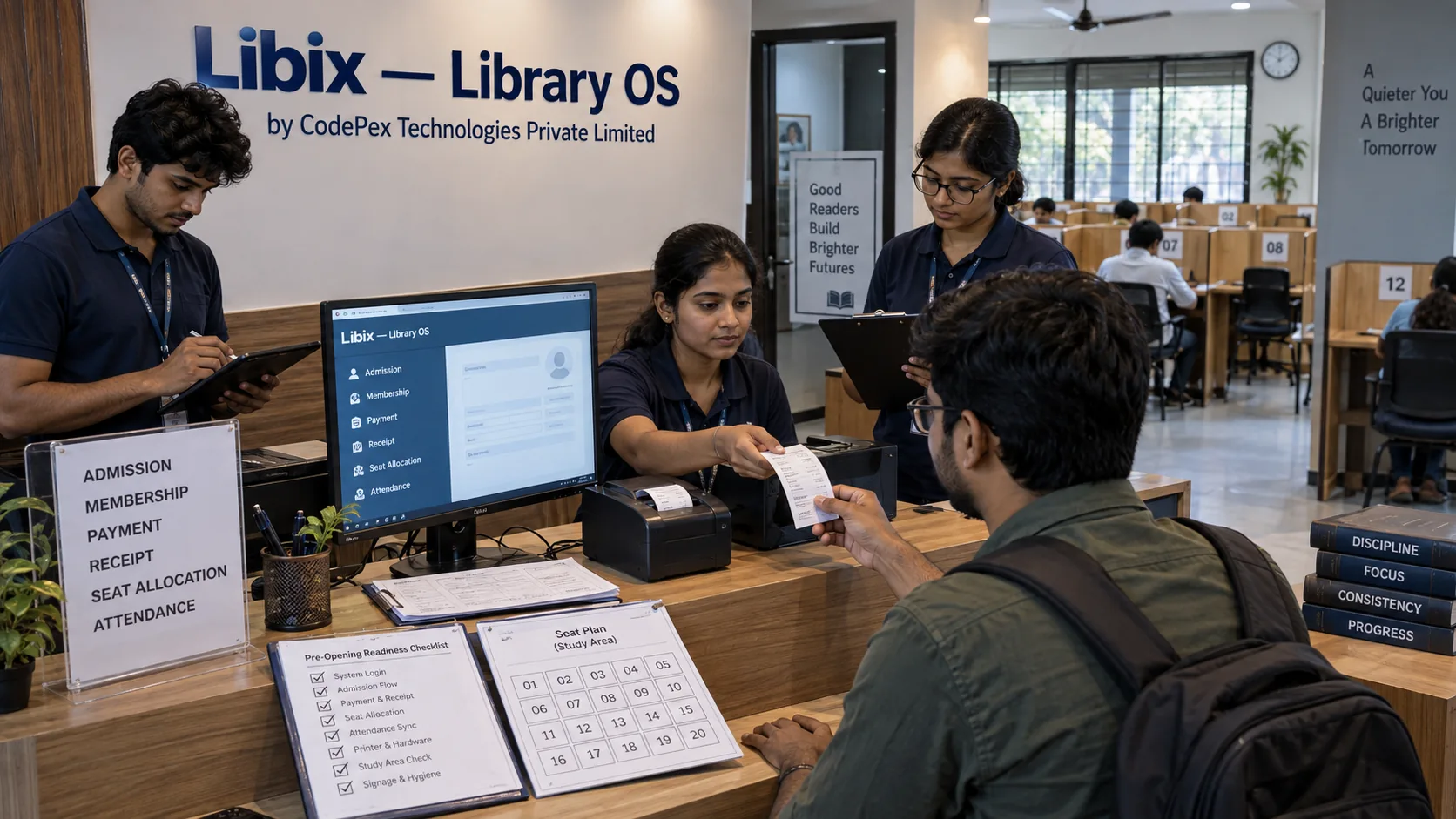
Opening-day checklist
First 7, 30 and 90 days
First 7 days
Observe real enquiries, admissions, payments, receipts, seat issues, complaints, utilities, cleaning and staff handovers. Capture defects without blame.
First 30 days
Review plans, demand evidence, dues, renewals, expenses, attendance context, member feedback and the post-opening backlog.
First 90 days
Compare assumptions with observed evidence, review recurring issues, update processes, decide what to improve and preserve what is working.
Where Libix fits
Configure and test the operating layer
Libix is positioned around study-library operations such as members, memberships, plans, seats, shifts, attendance, fees, payments, receipts, renewals, staff and reporting. Specific current capabilities, permissions, integrations and automation must be verified against approved product documentation and the current repository. Software configured is not a process tested.
Interactive launch planning
Turn planning into evidence and decisions
Completion percentage measures checklist administration only. It is not a business-readiness score, safety declaration, legal conclusion, profitability forecast or guarantee of success.
Checklist completion
0%
0 of 16 items marked verified or not applicable.
Launch decision still requires human review of blockers, dependencies, evidence and local requirements.
Opening readiness review
Classify unresolved issues; do not let the tool declare readiness automatically.
Classified issues: 0. Record the rationale before overriding a conditional issue.
Financial assumption worksheet
Illustrative monthly revenue: ₹54,000
Illustrative monthly costs: ₹1,15,000
Setup plus working capital entered: ₹6,50,000
Illustrative calculation based on user inputs; not an industry benchmark, financial forecast or guarantee.
Frequently asked questions
What should I do first before starting a study library?
Define the service and intended customer, then investigate local demand before committing to a property or large setup spend.
Should I choose a property first?
Not usually. A property should be evaluated against the service, catchment, access, capacity, safety, utilities, cost and operating assumptions—not selected in isolation.
How many seats should I plan?
Use local demand evidence, space, service expectations, capacity definitions, costs and operating constraints. There is no universal starting-seat number.
Do I need software before opening?
Not necessarily. Configure and test the records and workflows you genuinely need. Software configured is not the same as a process tested.
What should block opening?
Material safety, access, payment, receipt, member-entitlement, critical-utility, staffing or other control failures should be resolved or explicitly governed before normal operations.
Does completing this checklist guarantee success?
No. It improves preparation and exposes assumptions; it cannot guarantee demand, profitability, compliance, retention or business success.