
Research guide · India · 12 min read
How Much Investment Is Needed to Start a Study Library in India?
A practical planning guide for separating setup cash, refundable commitments and the working capital needed to give a new study library room to settle.
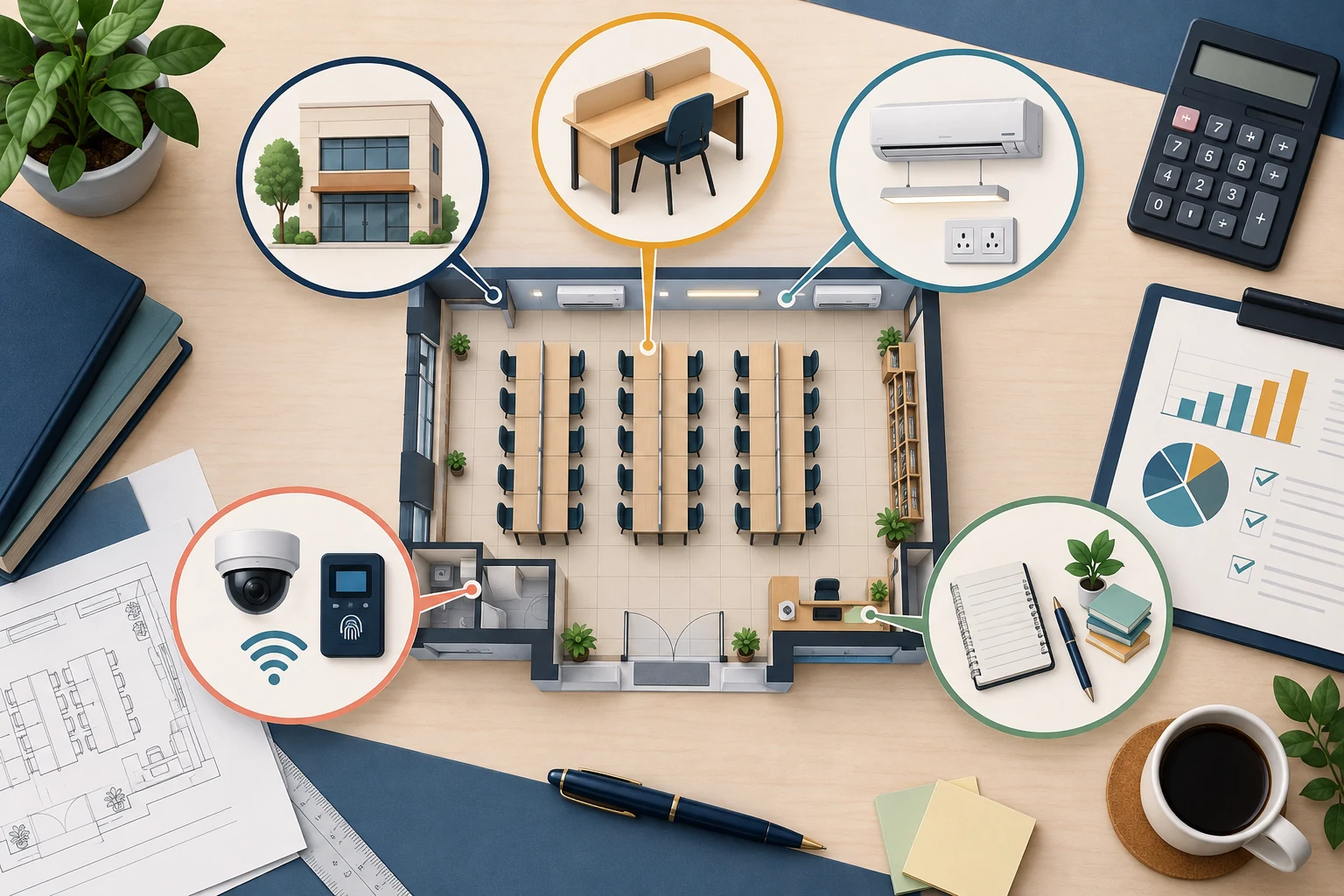
The short answer
If you are asking, “How much investment do you need for a study library?”, there is no single amount that applies to every setup in India. The requirement depends most heavily on the city, floor area, lease terms, number of seats, quality of furniture, cooling plan and how much cash you keep after opening.
For a planning conversation, this guide uses two illustrative scenarios:
- 50 seats: ₹6.25 lakh of illustrative setup cash, plus ₹2.20 lakh for four months of a ₹55,000 monthly fixed-cost reserve: ₹8.45 lakh planned capital.
- 100 seats: ₹10.10 lakh of illustrative setup cash, plus ₹3.80 lakh for four months of a ₹95,000 monthly fixed-cost reserve: ₹13.90 lakh planned capital.
These are planning scenarios, not market averages, quotations or guarantees. They deliberately keep the setup calculation and working capital visible as separate decisions.
Think in five investment buckets
Before collecting individual quotes, put every item into one of five buckets: premises and access to the space; furniture and member comfort; electrical, cooling and backup infrastructure; security, connectivity and admin technology; and working capital after opening.
This prevents a common planning error: treating the lease deposit as if it were the only capital requirement, then discovering that the first quiet months are underfunded. It also keeps a refundable deposit distinct from money that is consumed during setup.
1. Premises: the largest variable
Rent is only one part of the premises decision. Add the refundable security deposit, advance rent, brokerage or documentation, basic repairs, painting, partitions, washroom readiness, access hours and any building restrictions that affect your operating model.
A cheaper location can still need more work before the first member arrives. A higher-rent location might reduce fit-out, transport or visibility costs. Compare the whole opening cash requirement and the recurring monthly commitment, not just the advertised rent.
2. Furniture: cost per seat is not the whole story
Seat furniture is easy to multiply, which is why it often becomes the headline number. Also budget for reception or check-in furniture, storage, shoe racks if your format needs them, staff seating, noticeboards, partitions, lighting fixtures and replacement items.
The useful question is not “What is the cheapest desk?” but “What can withstand daily use, clean easily and preserve a consistent member experience?” A small saving per seat can be outweighed by repairs, uncomfortable spacing or an early replacement cycle.
3. Electrical, cooling and power backup
Electrical work may include load assessment, rewiring, additional sockets, distribution boards, lighting, fans, earthing and installation. Cooling can range from ventilation and fans to split AC or a larger planned system. Your choice affects both setup cash and monthly electricity.
Power backup should be planned around the actual load you cannot afford to lose: lights, network equipment, access control, CCTV and essential desk systems. Ask an electrician to size it safely rather than copying a number from another premises.
4. Security, internet and admin technology
Include CCTV, recording, access control if used, router and network cabling, a reliable internet connection, a reception device, printing or scanning needs, and basic data-handling procedures. Security is both a member-trust decision and an operational continuity decision.
Do not make software the centre of the opening budget, but do not leave it until the last day either. A system for seat assignment, member records, attendance and fee follow-up can reduce manual work once the operating process is clear. Ask for a demonstration and confirm the commercial terms before treating any trial or feature claim as part of your plan.
5. Working capital: the buffer after opening
Setup cash gets the doors ready; working capital gives the business time to find its operating rhythm. Model rent, utilities, internet, cleaning, staff or desk support, repairs, software, payment charges and recurring marketing. Keep owner drawings and one-off purchases explicit instead of hiding them in a vague miscellaneous line.
A reserve measured in months is easier to reason about than a single guessed amount. Four months is used in the examples below only to demonstrate the method. Your reserve may need to be shorter or longer depending on your pre-launch bookings, personal obligations and occupancy assumptions.
Illustrative 50-seat and 100-seat scenarios
These examples make the categories concrete. They are not averages for India and should not be copied as a quotation. Replace every line with a local quote or your own assumption.
| Setup bucket | 50 seats | 100 seats |
|---|---|---|
| Refundable deposit | ₹1,50,000 | ₹2,50,000 |
| Advance rent, brokerage and documentation | ₹75,000 | ₹1,25,000 |
| Premises and interior preparation | ₹1,00,000 | ₹1,60,000 |
| Seat furniture | ₹2,25,000 | ₹4,50,000 |
| Common furniture and storage | ₹30,000 | ₹55,000 |
| Electrical, lighting and wiring | ₹60,000 | ₹1,00,000 |
| Cooling / AC provision | ₹75,000 | ₹1,20,000 |
| Power backup | ₹35,000 | ₹60,000 |
| CCTV and security | ₹25,000 | ₹45,000 |
| Internet, admin technology and signage | ₹35,000 | ₹55,000 |
| Other setup and contingency | ₹80,000 | ₹1,30,000 |
| Illustrative setup cash | ₹6,25,000 | ₹10,10,000 |
| Planning layer | 50 seats | 100 seats |
|---|---|---|
| Illustrative monthly fixed cost | ₹55,000 | ₹95,000 |
| Four-month reserve | ₹2,20,000 | ₹3,80,000 |
| Planned capital including reserve | ₹8,45,000 | ₹13,90,000 |
Planning worksheet
Build your own investment estimate
Enter the figures you are currently considering. The calculator separates committed cash, setup costs and the reserve you want to protect after opening.
Lean, standard or premium: choose deliberately
Lean
A smaller footprint, essential furniture, restrained interiors and a carefully protected reserve. Useful for testing demand when the location and operating hours are already clear.
Standard
Durable seating, dependable power and internet, visible security and enough working capital to make decisions without immediate cash pressure.
Premium
Higher finish, stronger cooling, more common facilities and additional service layers. It only makes sense when the local price and occupancy plan support the commitment.
Premium design is not automatically better economics. The right tier is the one whose additional capital has a clear job: comfort, retention, operating reliability, positioning or a measurable reduction in future rework.
Where new owners overspend
- Finishing every room before validating the seat demand and operating hours.
- Buying furniture without measuring walkways, service access and cleaning routines.
- Choosing cooling or backup capacity without understanding the electrical load.
- Locking too much cash into decorative work while underfunding the first few months.
- Paying for software or services before checking the workflow, support terms and data ownership.
Where new owners underinvest
Cutting the reserve is often more dangerous than choosing a modest interior. Likewise, poor lighting, unreliable internet, weak security or uncomfortable furniture can create daily friction that members notice immediately. Spend first on the parts that protect continuity and the member experience.
Do a simple “what breaks first?” review before opening. Include a replacement allowance for furniture, electrical accessories, network equipment and small repairs. Contingency is not an admission that the plan failed; it is part of an honest plan.
Registration and compliance are separate checks
Udyam registration is available through the official government portal as a free and paperless MSME registration process: udyamregistration.gov.in. Use the official site and treat registration as one part of the setup checklist.
GST registration is not a universal “yes” or “no” based only on the word library. The general threshold under Section 22 is subject to exceptions and the facts of the supply. Check current official material from CBIC and get professional advice before relying on a threshold or assuming that no local permission is needed.
Before committing money: a 10-question checklist
- How many seats can the premises hold without crowding?
- What are the deposit, advance and exit terms?
- What work is required before furniture arrives?
- What will each seat cost after delivery and installation?
- How will cooling affect monthly electricity?
- What loads must the backup support?
- What security and internet setup is necessary?
- What are the monthly fixed costs at 50% occupancy?
- How many reserve months are personally comfortable?
- Which claims or prices still need a written quote?
A worksheet you can keep updating
Copy the calculator categories into your planning sheet and add three columns: “assumption”, “quote received” and “paid or committed”. Review the sheet whenever the lease, seat count or cooling plan changes. The goal is not to make every number precise on day one; it is to expose which numbers are still uncertain.
The core formulas:
- Seat furniture = seats × furniture cost per seat
- Setup cash = deposit + advance + brokerage + premises + furniture + systems + contingency
- Working capital = monthly fixed cost × reserve months
- Total planned capital = setup cash + working-capital reserve
Where Libix fits after the plan is clear
Once the premises, seats and operating process are understood, software can help turn the plan into repeatable daily work: member records, seat assignment, attendance and fee follow-up. Libix is designed for library operators who want that operational layer in one place. Evaluate it against your workflow, ask for the current terms and make the decision from your own budget rather than treating software as a substitute for local market research.
The most useful next step is to run a few scenarios: a slower opening, a higher electricity bill, a larger deposit and a longer reserve. If the plan still feels manageable, you have learned more than a single headline startup figure could tell you.
Frequently asked questions
How much investment do you need for a study library?
There is no universal amount. The required capital depends on the number of seats, rent and deposit, condition of the premises, furniture, electrical work, cooling, power backup, security, technology and working capital. Separate premises commitments, setup expenditure and the reserve needed while membership grows.
How much investment is needed to start a study library in India?
There is no single national figure. For planning only, this guide models ₹6.25 lakh of setup cash for a 50-seat scenario and ₹10.10 lakh for a 100-seat scenario, before adding a separate operating reserve. Your rent, deposit, fit-out and cooling choices can move the result materially.
Is a refundable security deposit an expense?
It is usually a cash requirement and a commitment, but it is not the same as a non-refundable operating expense. Show it separately in your plan so you understand both the cash needed and the money that may be recoverable later.
Do I need GST registration for a study library?
GST registration is not universal for every new business. The general threshold and exceptions depend on the nature of supply, turnover and other facts. Verify the current position with a qualified tax professional or the official CBIC material before relying on a threshold.
Should I register under Udyam before opening?
Udyam registration is a free, paperless MSME registration route on the official government portal. Whether and when you register is a business decision, but use only the official portal and keep the result separate from local permissions, tax registration and lease requirements.
How much working capital should I keep?
A practical planning range is several months of fixed costs, not just the first month. The right reserve depends on rent, staffing, utilities, launch speed, occupancy and personal risk tolerance; use the calculator to test different reserve periods.
Plan the number you can explain
A good investment plan is not the biggest number or the smallest number. It is a set of assumptions you can explain, test and revise before signing commitments.