
Software fundamentals · System definition
What Is a Study Library Management System?
Understand the connected operating model behind a paid self-study library, reading room or study hall—from members and memberships to seats, attendance, money, renewals and management decisions.
Quick answer
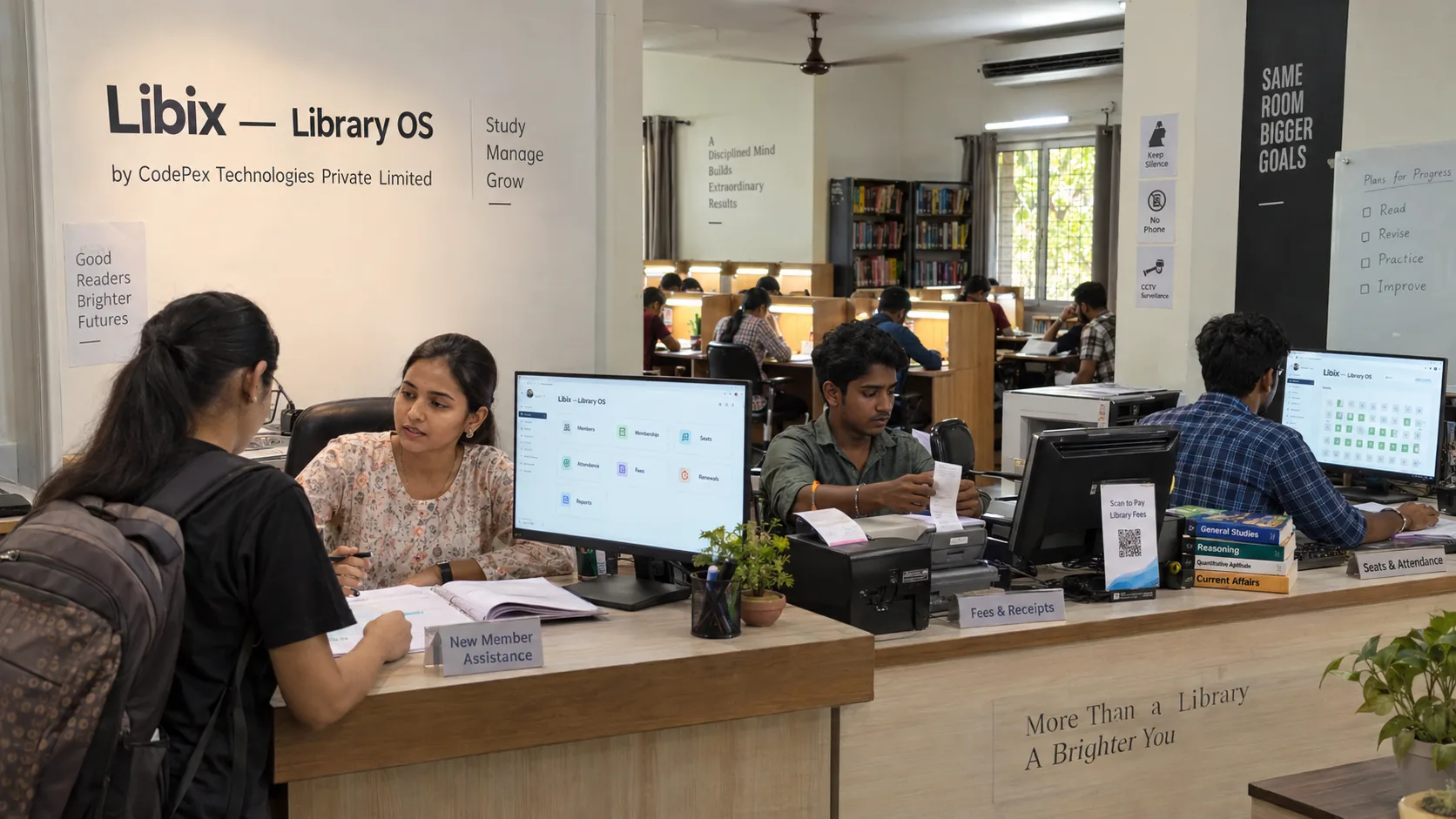
A study library management system is software designed to manage the recurring operations of a paid private study library, reading room or study hall. The important word is connect. A register may record attendance and a spreadsheet may store members, but a system aims to connect identity, entitlements, capacity, presence, money, history and management information.
Members
Who the person is and how the relationship persists
Operations
What entitlement, seat, shift, attendance and service events occur
Management
What was charged, paid, renewed, reviewed and decided
The definition in context
Here, a study library means a commercial or organized self-study space where members pay for access to a study seat, a time period or shift, a quiet environment and supporting facilities, sometimes including lockers or other services. The main operating problem is therefore membership + capacity + time + attendance + money + service—not book circulation.
Who uses the system?
Depending on size, users may include an owner, receptionist, admissions or fee-collection staff, operations staff, branch manager, finance staff, staff administrator and system administrator. A small library may combine roles; a multi-branch business may divide them. The system should support the operation rather than force every library into one staffing model.
The connected operating model
Imagine one hypothetical member journey: an enquiry is received, a member record is created, a plan is selected, a membership begins, a shift and seat are allocated, attendance is recorded, charges are created, payment is collected, a receipt is issued, expiry approaches and the member renews. The previous membership remains history. Reports can then inform decisions.
Member
The person using or enquiring about the service.
Plan
A reusable commercial or operational definition.
Membership
A member’s time-bound entitlement under a plan.
Seat/allocation
The physical resource and the relationship assigning it.
Attendance
Evidence of presence according to the operating process.
Payment/receipt
Money received and the acknowledgement or evidence of that payment.
How the main records fit together
Enquiries and admissions
An enquiry can exist before a person becomes a member. Admission should create a controlled transition without collecting unnecessary data.
Members, plans and memberships
The member is the person, the plan is a reusable definition and the membership is the time-bound entitlement. One member can have multiple memberships.
Seats, shifts and attendance
A seat is capacity, an allocation connects it to a member or membership for a period, a shift is a time window and attendance records presence. None automatically proves occupancy.
Charges, payments, receipts and dues
A charge or invoice describes what is owed, a payment records money received, a receipt acknowledges it and dues require a clear obligation and settlement context.
Renewals, refunds and history
Renewals should preserve lifecycle events. Refunds and reversals should preserve original transaction evidence and authority rather than silently deleting the past.

Supporting layers: staff, communication, finance and reports
Optional or conditional modules may include lockers, staff attendance and leave, payroll, communication templates, complaints and feedback, expenses, vendors, cash closing and reconciliation. Reports should derive from defined source records, filters and date bases. A dashboard is not automatically a source of truth, and a system should not be described as full accounting software unless that capability is actually verified.
Multi-branch, access, history and security
Multi-branch capability is more than a selector: it may require branch-scoped users, resources, finance, configuration and reporting alongside appropriate central visibility. Roles group permissions; individual permissions should be scoped and enforced server-side. Audit history identifies who did what and when. Security, backups and recovery support the system but are not the same as operational truth.
Manual records, spreadsheets and an integrated system
Manual registers
Useful for simple local records, but relationships, history and shared visibility can be difficult to maintain.
Spreadsheets
Flexible and familiar, but duplicate entry, permissions, corrections and connected reporting require discipline.
Integrated system
Designed to connect records and workflows, but still requires configuration, controls, training and evaluation.
Small, growing and multi-branch needs
Small libraries may begin with members, plans, memberships, seats, payments, receipts, renewals and basic reporting. Growing operations may need role separation, history, complaints, expenses, reconciliation, export and structured reviews. Multi-branch operations may add branch governance, consolidated reporting, cross-branch permissions and more disciplined configuration. There is no universal seat or complexity threshold.
What a good system should not do
It should not encourage duplicate entry everywhere, destructive corrections, shared administrator credentials, spreadsheet dependence for every report or unrestricted access. It should not promise that software fills seats, eliminates staff, guarantees profit or replaces every manual decision. Evaluate the real workflows, relationships, history, permissions, migration needs and cost—not only the feature list.
Where Libix fits
Verify the current product surface
Libix—Library OS is study-library management software from CodePex Technologies Private Limited for private study libraries, reading rooms and related self-study operations. Current modules, pricing, trial, infrastructure, security, integrations, AI, backups and export must be verified against the current repository and approved documentation. This page defines the category; it does not claim every capability is implemented.
Educational system mapper
See whether daily work is fragmented or connected
This is a conceptual mapper, not a software audit, product recommendation, financial assessment or suitability guarantee. It uses no identity, contact or financial data.
Library profile
Structure
Insufficient Information
Record a few current methods and relationship answers to begin.
Current process method
Relationship check
Frequently asked questions
What is a study library management system?
It is software that organizes and connects the recurring business and operational processes of a paid self-study library, reading room or study hall through structured records and workflows.
Is it the same as traditional library software?
Not necessarily. Traditional library software often focuses on books, cataloguing and circulation; a private study-library system focuses more on members, memberships, seats, shifts, attendance, fees, renewals and service operations.
What is the difference between a member and a membership?
A member represents the person. A membership represents a particular entitlement or period under which that person uses the library. One member can have multiple memberships over time.
Does a seat allocation prove attendance?
No. Allocation records entitlement or assignment. Attendance records presence according to the library’s process. Occupancy is a separate metric with its own denominator and time basis.
Does every library need every module?
No. The appropriate system depends on the library’s operating model, size, services, roles, branches, transaction volume and reporting needs.
Where does Libix fit?
Libix—Library OS is study-library management software from CodePex Technologies Private Limited. Current capabilities should be verified against the repository and approved product documentation.