
Software evaluation · Capability reference
What Features Should Study Library Management Software Have?
A business-first capability map for defining requirements—from members, plans, seats and collections to permissions, history, reporting, export and responsible automation.
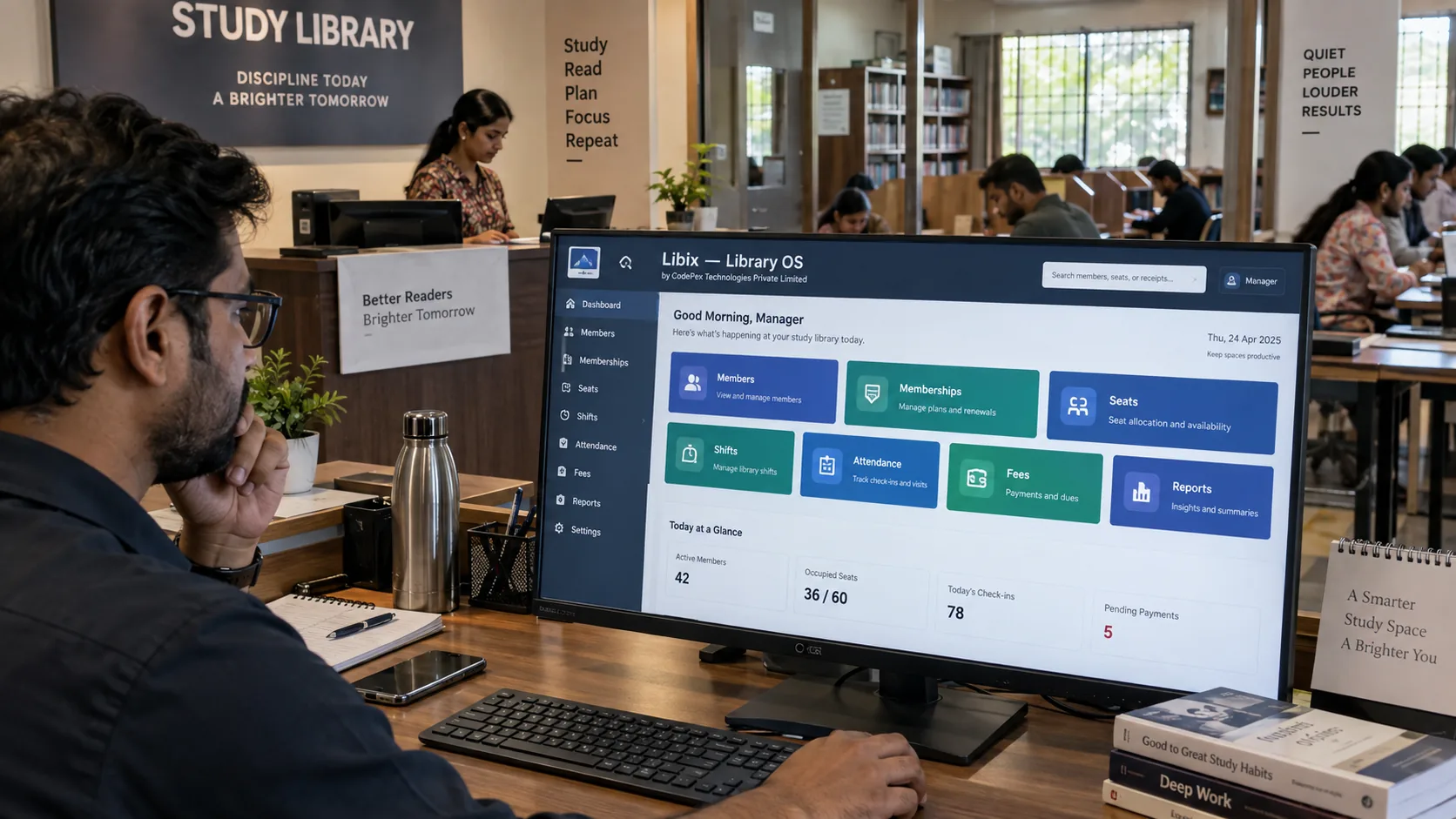
Quick answer
Serious study-library software should connect organization, users and access, enquiries, admissions, members, plans, memberships, seats, zones, shifts, attendance, fees, charges, payments, receipts, dues, renewals, communication, reports, configuration, audit, security, export and recovery. Conditional modules may include lockers, payroll, vendors, multi-branch governance, APIs, automation and AI.
Core
Needed by most professionally managed libraries
Conditional
Important when that operating model exists
Growth / Advanced
More valuable as scale and complexity grow
How to use this feature list
A feature should solve a defined operating problem. Check its records, validation, permissions, exceptions, history and reporting—not just its label. A 150-feature product is not automatically better than a 60-feature product.
The complete capability architecture
Use this lifecycle to test whether separate modules actually connect. Each transition should preserve identity, authority, history and enough evidence for the business question being asked.
Organization and access
Organization profile, branches, users, roles, permissions, branch scope, authentication and deactivation.
Enquiries and admissions
Prospect lifecycle, duplicate prevention, admission number, plan, dates, charges, documents and activation.
Members and memberships
Stable member identity, plans, entitlements, renewals, expiry, extensions, freezes, cancellations and history.
Capacity and attendance
Seat master, zones, allocations, releases, shifts, capacity, attendance events, corrections and history.
Money and service
Charges, invoices, payments, allocations, receipts, dues, refunds, lockers, communication, complaints and feedback.
Management and control
Finance, KPIs, reports, dashboards, configuration, numbering, audit, security, export, backup, APIs and branch governance.
What the major modules should accomplish
Organization, branches, users and permissions
Keep organization, branch, user, role and permission entities distinct. Enforce branch and action scope server-side; hiding a button is not authorization.
Enquiries, admissions and members
Connect enquiry → follow-up → qualified → admission or deferred/lost, then create a controlled membership transition without conflating the person with the entitlement.
Plans, memberships, renewals and history
Keep reusable plan definitions separate from membership records. Preserve activation, renewal, expiry, extension, freeze, cancellation, plan changes and historical dates.
Seats, zones, shifts and attendance
Model seat identity, zones, allocations, release, conflict prevention, shifts and attendance events separately. QR or biometric features are conditional, not universal requirements.
Fees, invoices, payments, receipts, dues and refunds
Keep charge, invoice, payment, allocation, receipt, outstanding balance, refund and reversal traceable. Preserve original transactions and authorized correction history.
Communication, complaints, finance and reporting
Support templates, targeting, reminders and message history; assign complaints and preserve resolution; define metrics, date basis, filters, exclusions and drill-down to source records.
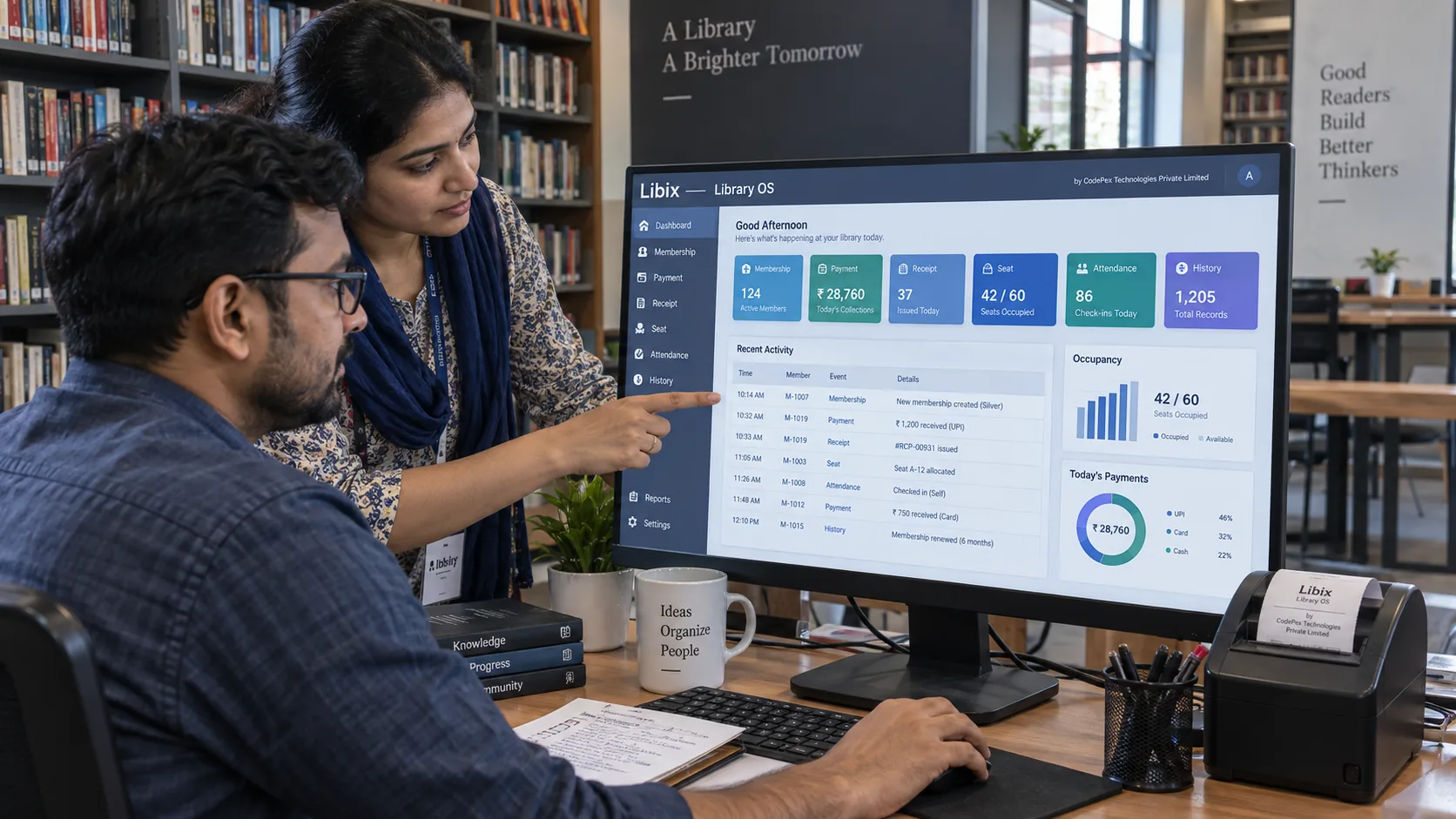
Control, data and reliability features
Configuration and numbering
Permission-controlled settings, effective dates and separate business numbers from database IDs.
Audit and security
Secure authentication, branch authorization, deactivation, actor/action/time/entity history and before/after evidence where appropriate. Avoid absolute security promises.
Export and backup
Structured export with relationships and financial history; backup paired with a tested restoration process.
Multi-branch
Branch-scoped users, resources, finance, configuration, reporting and consolidated governance—not just a branch dropdown.
APIs and integrations
Conditional capabilities with authentication, authorization, stable IDs, versioning and careful secret handling.
Automation and AI
Standardize → validate → automate. AI outputs should be reviewable and must not silently mutate sensitive financial or membership records.
Usability and mobile
Search, filters, pagination, history, date ranges, accessible forms, responsive access and clear error states.
Performance and recovery
Predictable queries, indexing, graceful errors, observability, idempotency where relevant and recoverable operations.
Minimum, growth and multi-branch sets
Minimum set
Members, plans, memberships, seats, shifts, attendance, collections, receipts, renewals, reporting, access and reliable history.
Growth set
Advanced roles, complaints, expenses, vendor context, reconciliation, exports, audit, integrations and workflow automation as justified.
Multi-branch set
Branch-scoped operations, branch finance, configuration, staff scope, consolidated reporting, comparisons and governance.
These are contextual reference sets, not universal requirements.
Features not to overvalue
Do not overvalue feature count, dashboards, AI, customization, report count, a mobile badge or “unlimited” language. Feature presence does not prove workflow quality, source reconciliation, usable permissions, reliable history, supportability or fit with the actual operation.
Where Libix fits
Verify the current product surface
Libix—Library OS is study-library management software from CodePex Technologies Private Limited for private study libraries, reading rooms and related self-study operations. Current capabilities, pricing, trial, support, security, APIs, apps, AI, export and multi-branch behavior must be verified against the current repository and approved documentation. Feature presence is not presented as proof of quality.
Requirements lab
Build an owner-specific feature brief
This educational builder creates a requirements summary. It does not rank vendors, recommend a product, persist data or require real business information.
Capability groups
Must-have list
No must-have capabilities selected yet.
Acceptance criteria needed
Every selected item has a criterion.
Next step
Test these requirements using the software-selection framework.
Complete requirements checklist
Frequently asked questions
What are the essential study-library software features?
Most professionally managed operations need organization and access, enquiries or admissions where relevant, members, plans, memberships, seats, shifts, attendance, collections, receipts, renewals, reporting, configuration and data controls.
Does every study library need every feature?
No. Classify capabilities as Core, Conditional or Growth/Advanced according to the real operating model. Lockers, payroll, multi-branch governance, APIs, automation and AI may not apply to every library.
Why separate members and memberships?
A member represents a person; a membership represents a particular entitlement over a period. Keeping them distinct preserves history when plans, seats, dates or renewals change.
Are dashboards and feature counts enough to judge software?
No. A feature label is not a complete workflow. Check records, validation, permissions, exceptions, history, source reconciliation and actual acceptance criteria.
Should study-library software include AI?
AI is optional. It should not replace operational correctness, authoritative records, staff judgment or controls. Any AI output should be reviewable and should not silently mutate financial or membership data.
Where does Libix fit?
Libix—Library OS is study-library management software from CodePex Technologies Private Limited. Current capabilities should be verified against the repository and approved product documentation before publication or procurement decisions.