
Financial strategy · Hidden-loss diagnosis
Where Study Libraries Lose Money Without Realizing It
Find the less-visible ways economic value disappears across capacity, pricing, renewals, collections, staffing, utilities, purchasing, marketing, manual work and control gaps.

Quick answer
Study libraries do not lose money only when cash disappears. Economic value can quietly weaken when seats remain underused, high-demand hours are poorly configured, plans are underpriced, discounts become habitual, members do not renew, enquiries fail to convert, dues age, legitimate revenue is not recorded, staff time is misaligned, utilities or vendors are inefficient, marketing produces activity without admissions, or the owner repeatedly fixes preventable work.
The first task is classification. Do not call every problem revenue leakage, and do not turn an unexplained variance into an accusation.
Revenue opportunity
Capacity or demand is not converted into a reasonable paid outcome.
Revenue leakage
An earned or expected amount is not billed, recorded, collected or reconciled correctly.
Margin erosion
Revenue exists, but price, concessions or delivery cost leave weak contribution.
Cost waste
Resources are consumed without enough service or business value.
Working-capital drag
Cash arrives late while obligations continue.
Asset underutilization
Paid space, equipment or capacity produces less useful output than planned.
Productivity/control loss
Rework, manual effort or unresolved exceptions consume economic value.
Hidden-loss taxonomy
Where to look first
Build an economic baseline from your own seats, shifts, plans, realized prices, renewals, collections, costs, staff workload, owner time and branch structure. Then compare expected and actual operations without inventing an industry benchmark.
| Area | Evidence to review | Route |
|---|---|---|
| Capacity | Sellable seat-hours, allocation, attendance context, shift and zone patterns | Unused capacity / shift review |
| Memberships | Expiry, eligibility, renewals, late renewals and plan mix | Renewal review |
| Pricing | Approved price, realized price, concessions, plan entitlement and cost | Pricing / plan review |
| Collections | Dues age, payment promises, receipts, settlement and write-off status | Collection / cash-flow review |
| Costs | Staff workload, utilities, vendors, maintenance and space use | Cost-efficiency review |
| Productivity | Owner time, manual steps, rework, errors and branch duplication | Process / productivity review |
Quantify before prioritising
A materiality review should consider financial magnitude, frequency, controllability, service impact, implementation cost, evidence confidence and time to benefit. A small recurring error may deserve attention; a large theoretical opportunity may not be immediately controllable.
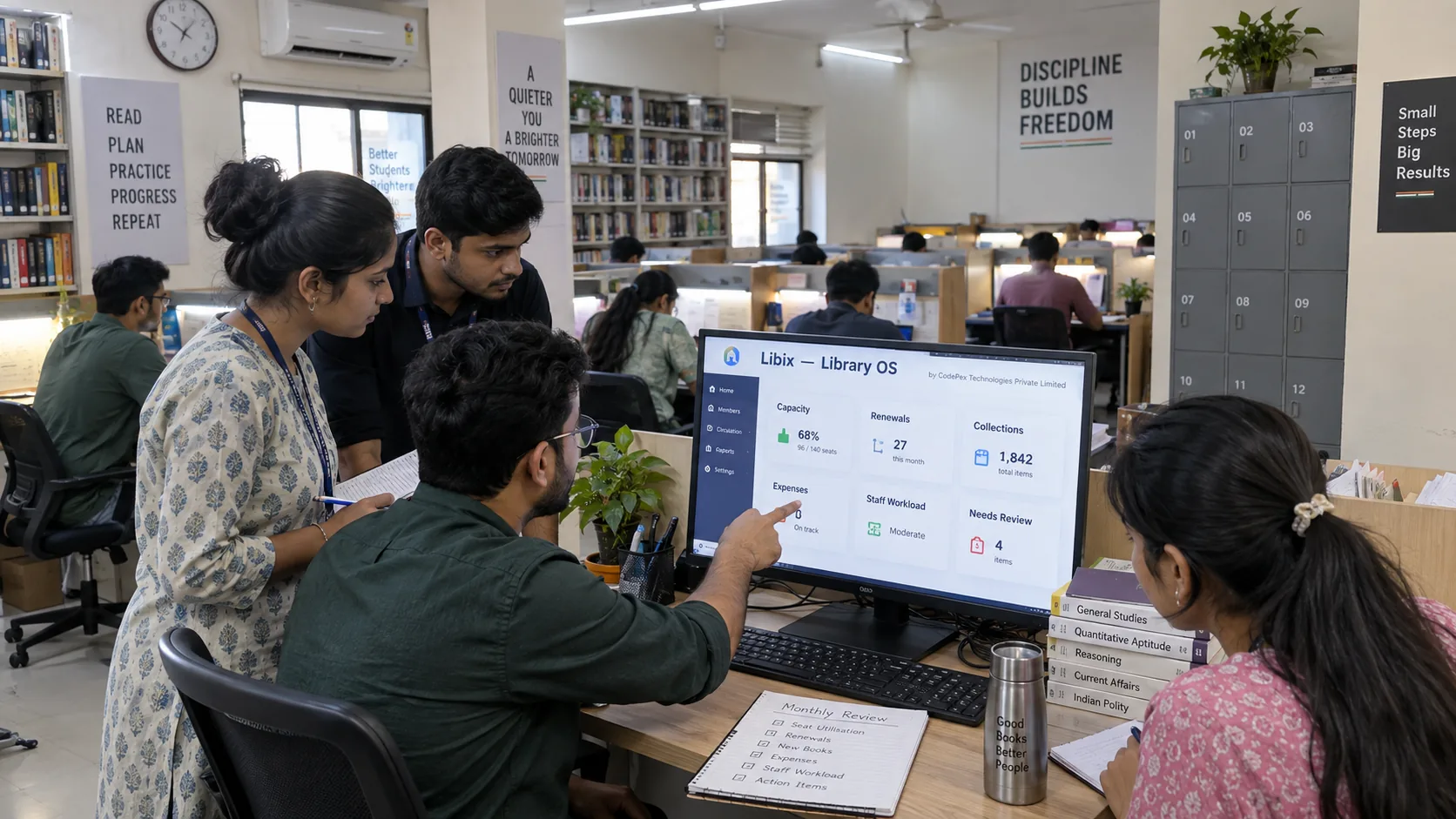
A monthly hidden-loss review
Review the same categories each month, preserve definitions and record whether a finding is stable, needs review, material or unsupported by enough evidence. Link every material finding to an owner, an action, a due date, a measure and a follow-up. Measure before and after; do not declare a saving because a plan was announced.
Baseline
Variance
Owner and action
Re-measure
Where Libix fits
Visibility supports better questions
A management system can help connect memberships, seats, shifts, attendance context, charges, payments, receipts, dues, renewals, expenses, staff responsibility, branches and reports. It should make definitions, permissions, source evidence, exceptions, history and exports understandable. This page does not claim that any current Libix dashboard or capability exists without repository and product verification.
Frequently asked questions
Where do study libraries commonly lose money?
Quiet losses can arise from unused capacity, weak shift design, underpricing, habitual discounts, weak renewals, slow collections, unnecessary work, utilities, space, vendors, maintenance, marketing, rework and duplicated branch overhead.
Is an empty seat revenue leakage?
Usually not. An empty seat is generally unused capacity or a revenue opportunity. Revenue leakage means an expected, earned or collected amount was not billed, recorded, collected or reconciled correctly.
Can a full study library still lose money?
Yes. Full seats do not prove strong unit economics. Pricing, plan entitlement, concessions, staffing, utilities, maintenance, payment costs, cash flow and owner time still need review.
Does higher revenue mean higher profit?
No. Profit also depends on costs, pricing quality, resource use and operating effort. Cash collection and profit are different views, and profit and cash flow are not interchangeable.
Are discounts always bad?
No. An approved discount can support a defined campaign, commitment or referral. Review its reason, approval, realized price, incremental admissions, retention and contribution rather than applying a universal rule.
How often should hidden losses be reviewed?
Use a monthly review for recurring categories, with deeper specialist analysis when a material or repeated variance is evidenced. Do not change a process based on one unexplained number.
Does Libix currently provide every dashboard described here?
This page describes an operating architecture and verification questions. Current product capabilities must be confirmed against approved product and repository documentation.