
Financial Strategy · Revenue assurance · Exception investigation
How to Detect Revenue Leakage in a Study Library
Reconcile entitlement, approved pricing, charges, collections, receipts, allocations, refunds, settlement and financial evidence—without turning every mismatch into an accusation.
Quick answer
Revenue leakage occurs when value a study library was legitimately entitled to bill or collect is not correctly charged, collected, recorded, allocated, settled or retained, and no approved reason explains the difference. Detect it by reconciling independent evidence across the lifecycle—not by staring only at total revenue.
Leakage ≠ low revenue · leakage ≠ low occupancy · mismatch ≠ fraud · exception ≠ employee misconduct · estimated leakage ≠ confirmed leakage.
What leakage means—and does not mean
Empty seats may be an occupancy or demand problem, not leakage. Outstanding dues may remain collectible. An approved discount, concession, valid refund, valid reversal, bad-debt treatment and timing difference each require their own classification. The page detects revenue-assurance exceptions; it is not a financial audit or tax audit.
Map the revenue lifecycle
Start with a member and an entitlement, apply the approved plan and concession, generate a charge, establish the amount due, collect a payment, issue or record a receipt, allocate the payment, control refunds and reversals, close cash or confirm digital settlement, reconcile bank evidence and reflect the financial movement. Each stage provides evidence that can be compared with another stage.
Member / membership
Plan / rate / concession
Charge / due
Payment / receipt
Allocation
Refund / reversal
Cash / bank settlement
Ledger / movement
Eight reconciliation checks
Entitlement → charge
Compare active membership, plan, duration, seat/shift, locker or add-on entitlement with the approved charge that should exist.
Approved price → actual charge
Check effective plan, branch, duration, shift, seat category, proration, concession, discount and applicable tax treatment.
Charge → collection
Separate fully paid, partially paid, unpaid, overpaid, adjusted, refunded, reversed and policy-approved write-off states.
Collection → receipt
Look for payment without receipt, receipt without payment, duplicate receipt, wrong member, wrong branch or amount mismatch.
Payment → allocation
A recorded payment can still be unallocated, allocated to the wrong obligation, duplicated or affected by reversal timing.
Refund/reversal → authorization
Trace original transaction, amount, reason, approval, method, destination, evidence and financial movement.
Cash/digital → settlement
Compare cash closing, provider status, settlement reference, recorded payment, receipt, fees, refunds and bank credit.
Movement → ledger
Compare source events and financial movements without assuming a software exception is an accounting conclusion.
Patterns worth investigating
These are exception patterns, not conclusions. Check approved policy, timing, source records, migration context and authorization before classifying.

Keep an exception register
Give each exception an identifier, type, detection time, branch, relevant membership reference, source transactions, expected amount, actual amount, variance, rule, evidence, reviewer, status, classification, root cause, confirmed amount, corrective action, approval and resolution date. Use states such as Open, Under Review, Awaiting Evidence, Timing Difference, Approved Adjustment, Data Error, Control Gap, Confirmed Leakage, Not Leakage and Resolved. Do not delete an exception to make a report look clean.
Investigate before confirming
- 1. Freeze or preserve source evidence.
- 2. Reconstruct expected entitlement and approved price.
- 3. Reconstruct actual charge, payment, receipt and allocation.
- 4. Check timing and settlement windows.
- 5. Verify authorization, concession, refund or reversal evidence.
- 6. Classify the exception.
- 7. Quantify only the confirmed amount.
- 8. Correct through an authorized workflow.
- 9. Identify root cause and strengthen the control.
- 10. Re-test the chain.
Daily, weekly and monthly controls
Daily
Cash close, payment/receipt pairing, digital success state, duplicates, unallocated payments, refunds and pending deposits.
Weekly
Entitlement-to-charge, price-to-charge, allocations, refunds, concessions, branches, settlement ageing and unresolved exceptions.
Monthly
Expected-to-billed, billed-to-collected, collected-to-settled, branch patterns, ageing, confirmed leakage, root causes and corrective effectiveness.
Use defined KPIs, not universal thresholds
Keep confirmed leakage amount, potential leakage, exception count, relevant transaction count, resolution time and recurrence separate. A leakage rate requires a confirmed-leakage numerator and an explicitly defined expected billable-revenue denominator over the same period and scope. Do not publish an industry benchmark or compare branches with inconsistent definitions.
Preventive controls and AI boundaries
Use role separation, approval limits, discount controls, stable numbering, idempotent payment processing, controlled corrections, visible audit history and reconciliation. Deterministic exact checks should come first. AI may prioritize exceptions or summarize evidence, but it must not autonomously accuse a person, mutate financial records, approve a refund or turn an anomaly into a legal conclusion.
India-specific records context
For GST-registered businesses, CBIC materials describe accounts and records maintained electronically, audit-trail/inter-linkage information and invoice or receipt-voucher particulars in applicable contexts. Applicability depends on the business and transaction; an internal receipt is not automatically a GST tax invoice, and this page is not tax advice.
Where Libix fits
Revenue assurance across connected operations
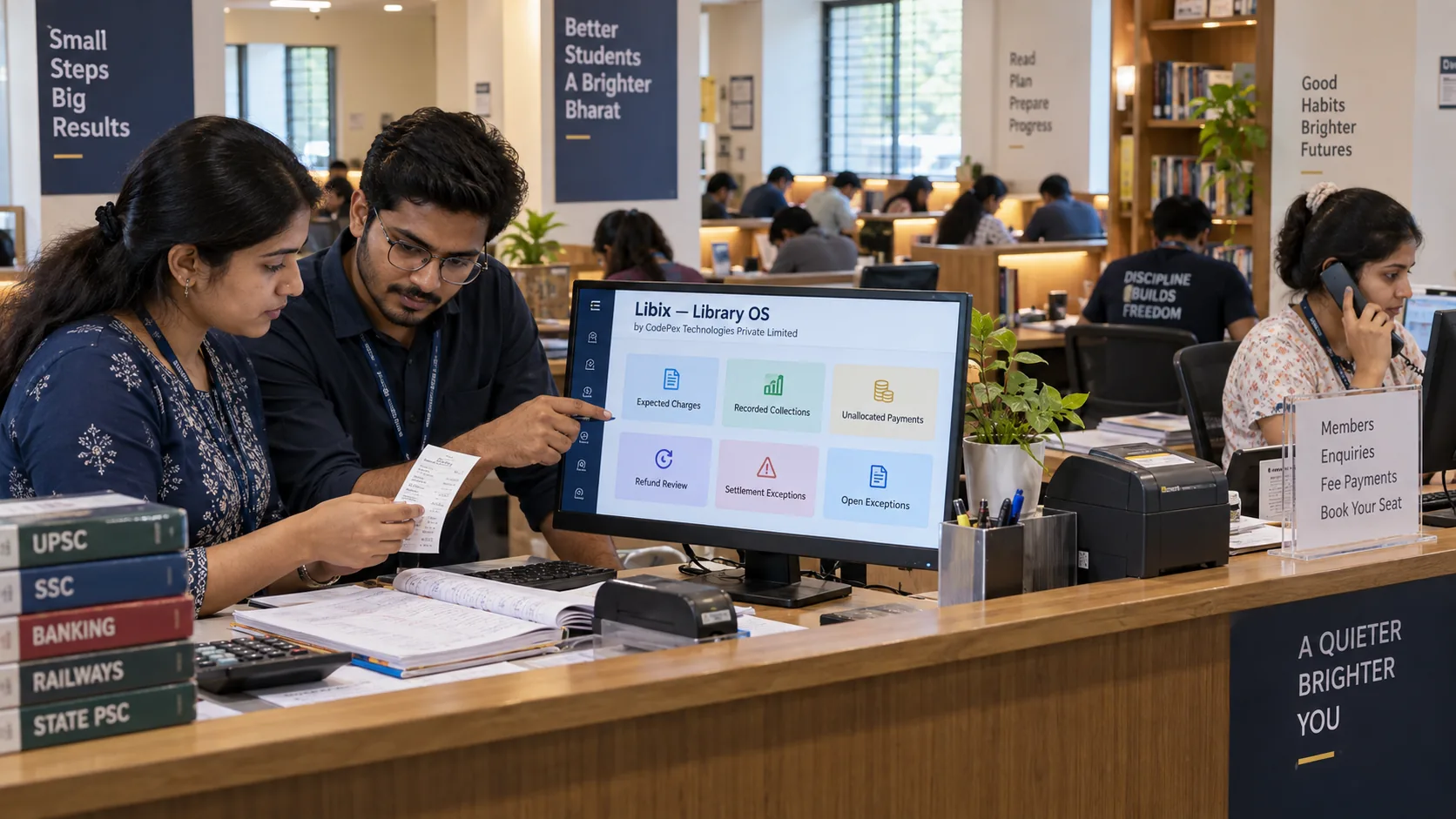
Libix is positioned around study-library operations involving memberships, plans, seats, shifts, attendance, fees, payments, receipts, renewals and management information. The availability of an exception engine, immutable financial movements, reconciliation, permissions, audit logs, idempotency, settlement integrations or automation must be verified against the current repository and approved product documentation before being described as implemented.
Interactive Revenue Leakage Diagnostic
Reconcile evidence without turning an exception into an accusation
Use fictional or aggregate values only. The diagnostic shows arithmetic differences and control prompts; it does not detect fraud, make a legal conclusion or identify an employee.
Reconciliation simulator
Educational calculation. A variance is not proof of leakage until investigated.
Control coverage map
Frequently asked questions
What is revenue leakage in a study library?
It is a measurable loss or omission of value the business was legitimately entitled to bill or collect when an approved reason does not explain the difference across entitlement, pricing, charging, collection, receipt, allocation, settlement or financial records.
Does a mismatch prove fraud or theft?
No. A mismatch is an exception to investigate. It may be a timing difference, approved adjustment, data error, migration issue, failed payment, control gap or genuine leakage.
Is an outstanding due automatically leakage?
No. An outstanding due is a collection issue or receivable until its status is understood. It is not automatically lost revenue or confirmed leakage.
How should a leakage rate be calculated?
Use a defined confirmed-leakage numerator and an explicitly defined billable-revenue denominator over the same scope and period. Do not use universal benchmarks or compare inconsistent denominators.