
Libix Logo· Library OS
  • FAQs
  • Features
  • Pricing
  • Solutions
  • About Us
  • Libix Learning
  • Libix Knowledge
  • Libix Learning/Financial planning/Partial payments

    Financial planning · collections

    How to Manage Partial Payments in a Study Library

    Record every payment independently, allocate it deliberately, calculate the remaining balance and keep the original obligation explainable.

    Indian study library administrator recording a partial membership payment

    Quick answer

    A partial payment reduces an obligation; it does not rewrite it

    Use the workflow: verify obligation → accept payment → record payment → allocate it → recalculate outstanding → issue receipt → update collection status → follow up → reconcile → preserve history.

    A partial payment is not a discount, installment plan, advance, refund or reversal. Those concepts can interact, but they represent different financial facts.

    Core formula

    Outstanding = Valid obligation − valid allocations

    Canonical model

    Charge → payment → allocation → remaining balance

    1

    Charge / invoice

    The valid obligation created for the member.

    ₹2,000 due

    2

    Payment

    Money actually received, recorded independently.

    ₹1,000 received

    3

    Allocation

    How a payment is assigned to one or more obligations.

    ₹1,000 allocated

    4

    Outstanding

    The valid amount still unpaid after allocation.

    ₹1,000 remains

    5

    Settlement

    The obligation is fully settled when valid allocations cover it.

    ₹0 remains

    Partial-payment calculator

    Keep the obligation intact while payments reduce it

    This illustrative tool shows the relationship between the original charge, independent payments and allocation. A production system must recalculate on the server.

    Result

    Payments received ₹1,500
    Allocated ₹1,000
    Unallocated ₹500
    Outstanding ₹500

    Allocation passes this illustrative integrity check.

    Allocation builder

    One payment can cover one or more valid charges

    Payment

    ₹1,500

    Recorded once with method and reference.

    Allocation

    ₹1,000 + ₹500

    Assigned to Charge A and Charge B under defined rules.

    Result

    Two balances reduced

    The payment is not duplicated; allocations explain its use.

    An allocation reversal corrects an incorrect assignment. It is not automatically a refund or a new payment.

    Receipt preview

    A receipt should explain the partial state

    Illustrative payment receipt

    Original charge: ₹2,000

    Payment received: ₹1,000

    Method: UPI / online

    Allocated now: ₹1,000

    Balance after allocation: ₹1,000

    Duplicate payment guard

    Investigate duplicate signals before posting

    Continue with normal allocation and reconciliation.

    Access versus payment

    Payment status is not membership status

    Payment stateMembership question
    Partial paymentWhat access policy applies?
    Outstanding balanceIs the membership active, expired or restricted?
    Paid chargeWhich period and entitlement does it settle?
    Reversed paymentWhat financial state remains?

    Integrity checklist

    Protect balances and history

    Completed checks: 0/8.

    Preserve the original obligation

    If a valid charge is ₹2,000 and a member pays ₹1,000, the charge remains ₹2,000. The payment is ₹1,000 and the valid outstanding amount is ₹1,000, subject to any defined discounts, credits, adjustments, reversals or other legitimate events. Editing the charge down to ₹1,000 hides the original obligation and makes later reporting unreliable.

    Record payments and allocations separately

    A payment answers how much money was received, when, by which method and with what reference. An allocation answers which valid charge or invoice that payment settles. One charge can receive multiple payments. One payment can cover multiple charges where the system and operating rules support that relationship. Do not rely on one ambiguous paid flag.

    Calculate outstanding deterministically

    Use a defined formula and consistent treatment of concessions, discounts, credits, refunds and reversals. A simple operational expression is outstanding = valid obligation minus valid allocations. The result should be recalculated from authoritative records, not accepted from a client-calculated balance. Over-allocation should be blocked or explicitly treated according to configured rules.
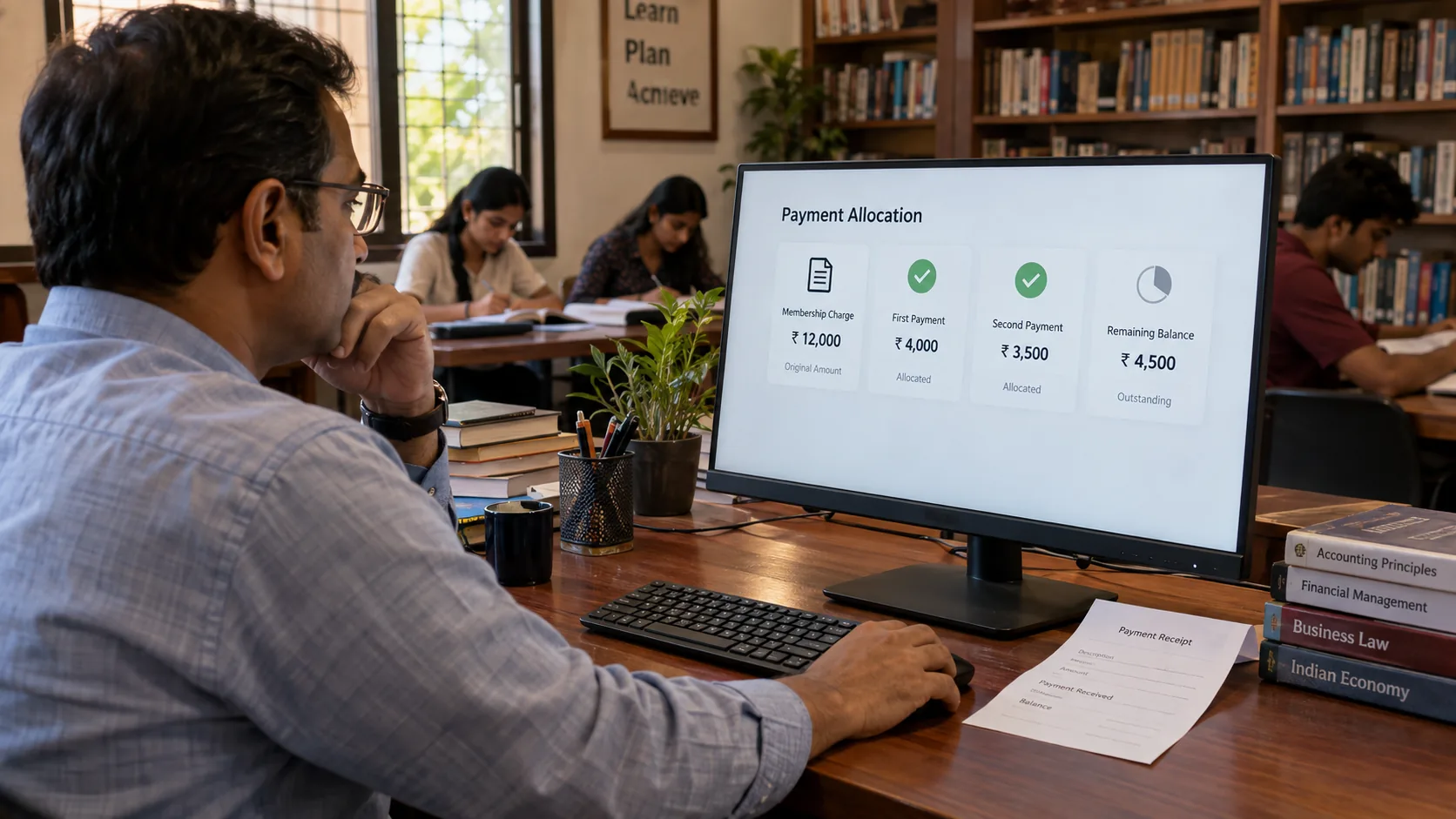
    Study library accounts manager reviewing original payment allocation history and updated balance

    Receipts should explain what was received

    A partial-payment receipt should show the source payment, method, reference, amount received and relevant allocation. Where the reporting model calls for it, show the original charge and remaining balance. Keep issued documents historically truthful; a later correction or reversal should be linked rather than silently rewriting the prior receipt.

    Access and payment are different decisions

    Whether a member may access the study library depends on the configured membership and access policy. A partial payment does not automatically imply active access, and an outstanding amount does not by itself describe membership status. Keep payment status, membership status, expiry, plan terms and any exception approval distinct.

    Corrections, duplicates and reversals

    If staff allocate a payment to the wrong charge, preserve the original payment and correct the allocation through an authorized event. If two records represent one real collection, investigate and preserve the source trail. If a payment is later reversed, its financial effect and resulting balance must be updated without pretending that the original event never existed.

    Follow up and reconcile

    Partial payments create a follow-up position: remaining amount, due context, next contact, responsible role and any member communication. Cash and electronic payments need their respective evidence and reconciliation paths. Reports should distinguish charges, collections, outstanding amounts, allocations, refunds and reversals. Revenue, collection, profit and cash are not interchangeable measures.

    Where Libix fits

    Make payment history and balances explainable

    Libix — Library OS is a study-library operations product from CodePex Technologies Private Limited. This guide describes the financial relationships that should be verified in the current implementation before making claims about partial-payment, allocation, receipt or reconciliation capabilities.

    Understand refunds and reversalsReview plan architectureReview revenue context

    Partial-payment SOP

    Before closing a partial payment

    □ Verify valid obligation
    □ Record source payment
    □ Allocate to valid charge
    □ Recalculate outstanding
    □ Issue accurate receipt
    □ Confirm access policy
    □ Set follow-up owner
    □ Reconcile evidence
    □ Preserve audit history

    FAQs

    Partial-payment questions

    What is a partial payment?

    A partial payment is money received against a valid obligation when the amount received is less than the amount currently due. It reduces the outstanding balance; it does not rewrite the original charge.

    Is a partial payment the same as a discount?

    No. A payment records money received. A discount changes the price or obligation under a defined rule.

    Should a membership be marked fully paid after a partial payment?

    Not unless valid allocations cover the relevant obligation. Payment status and membership status are separate questions.

    Can one payment cover multiple charges?

    Yes, where the financial model permits it. Each allocation should be explicit and the total allocations should not exceed the payment or valid obligations.

    What should a receipt show?

    It should identify the payment, method and reference, the relevant charge or allocation, amount received and the remaining balance under the applicable reporting rules.

    Back to Libix LearningBrowse Libix Knowledge

    Claim your 6 months Free Trial

    Start with a free demo or get in touch with our team to learn more about Libix and how we can help your library succeed.

    Call Us - +91 91700 91269Email Us

    Libix is the simplest library management software for modern libraries in India. Built to help library owners focus on their members instead of spreadsheets.

    CIN : U93000UP2017PTC091269
    URN : UDYAM-UP-50-0143487
    Privacy Policy·Terms & Conditions·Refund Policy·Trial Policy·Disclaimer·

    Libix is a proud product of CodePex Technologies Private Limited.
    © 2026 Libix · All rights reserved.