
Financial Strategy · Ledger · Movement traceability
How to Maintain a Study Library Ledger
Present collections, refunds, expenses, payroll and transfers as traceable financial movements without turning the ledger into a second place to invent transactions.
Quick answer
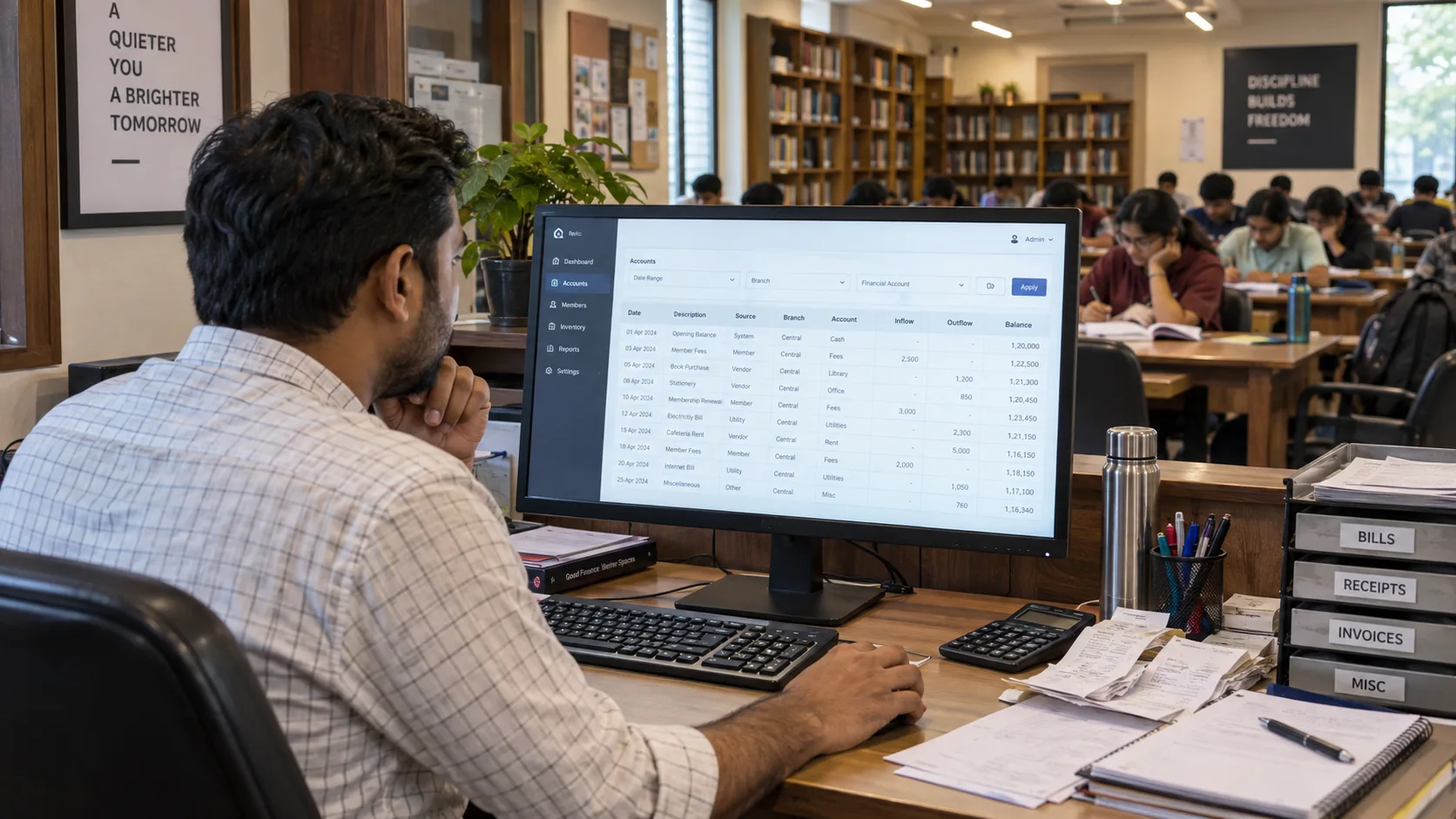
A study-library ledger is a chronological, traceable presentation of valid financial movements. Start with the business event and authoritative source record, derive the financial movement, present the ledger row, and provide source drill-down and reconciliation context. Do not make the ledger a manually edited duplicate of payments, expenses or transfers.
Ledger row ≠ source transaction · payment ≠ revenue · expense ≠ payment · transfer ≠ new income or expense · opening balance ≠ period income.
What a study-library ledger means
The ledger helps an owner inspect what moved, in which direction, on what effective date, through which financial account, for which branch, from which source record and with which later reversal or correction relationship. It is a financial traceability layer, not automatically a statutory book or general ledger.
| View | Primary question | Boundary |
|---|---|---|
| Operational ledger | What valid movement occurred and where can I trace it? | Movement-oriented |
| Payment register | What payment events were recorded? | Payment-focused |
| Cash book | What cash/bank-like movements are shown? | Depends on design |
| Accounting general ledger | What formal journal/account postings exist? | Double-entry/statutory context |
Ledger lab · illustrative inputs
Running balance only makes sense within a defined scope
Use one financial account, a stated opening point and a deterministic movement order. This calculator is educational and does not represent live Libix or bank data.
Illustrative closing
₹97,000
Formula
Opening + inflows − outflows
Scope warning
A defined account scope can support a meaningful running balance.
Source-to-ledger bridge
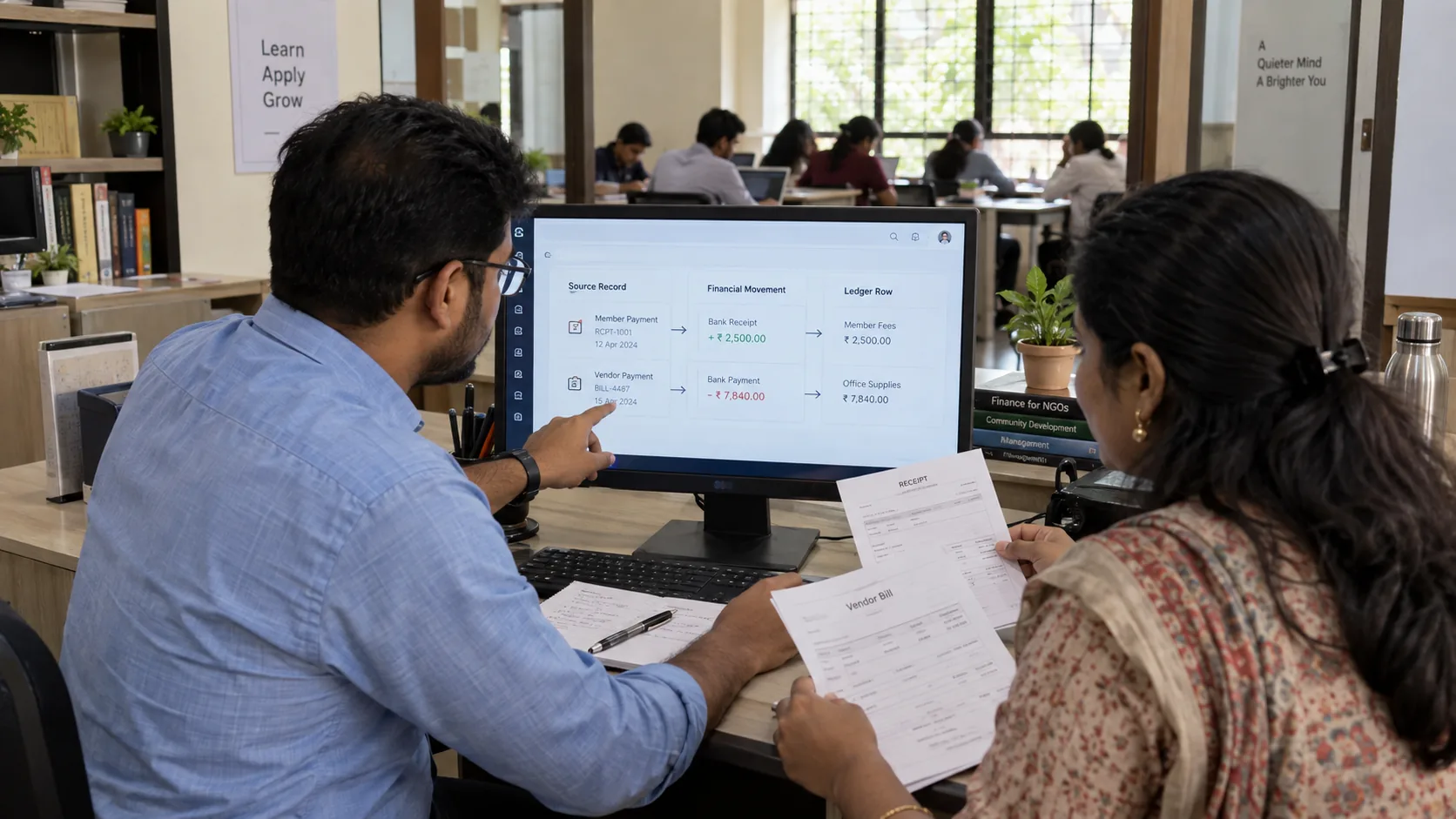
The ledger row should be traceable, not invented
| Date | Description | Source | Branch | Account | Inflow | Outflow |
|---|---|---|---|---|---|---|
| 2026-09-01 | Member payment | PAY-EXAMPLE-001 | Branch A | Cash | ₹1,500 | — |
| 2026-09-02 | Vendor payment | EXP-EXAMPLE-014 | Branch A | Bank | — | ₹8,000 |
| 2026-09-03 | Internal transfer | TRF-EXAMPLE-002 | Branch A → Central | Bank | ₹5,000 | ₹5,000 |
Anatomy of a financial movement
A movement needs enough information to explain its direction and source: movement identity, effective/business date, recorded timestamp, amount/currency, inflow or outflow direction, financial account, branch attribution, source type and source ID, description, actor/context where appropriate, and links to reversal or correction events. Use the actual canonical repository fields when implementing product behavior.
Do not infer economic meaning from direction alone
Inflow
Can include customer payment, advance, transfer receipt or another approved movement; not every inflow is revenue.
Outflow
Can include refund, vendor payment, payroll payment or transfer; not every outflow is expense.
Refund
A linked later event; do not delete the original payment movement.
Transfer
Show source outflow and destination inflow; avoid counting the internal movement as new organization income or expense.
Effective dates and recorded timestamps
An event may have an effective or transaction date and a recorded/created timestamp. Preserve both where the architecture needs them. Backdating can alter historical balances and reports; it does not justify falsifying when the record was actually created. Deterministic ordering should define how equal timestamps are displayed, using stable tie-breakers.
Source drill-down and duplicate prevention
Every ledger row should lead back to the authoritative source record and movement semantics that produced it. A source type plus source ID can support traceability and idempotency where the architecture permits. The same business event should not generate duplicate movements, and a ledger correction should begin in the source workflow so the presentation can be derived again.
Separate branch attribution from financial-account attribution
A movement can be collected through a central financial account while belonging operationally to a local branch. Preserve both concepts so an organization-level view can aggregate without losing branch drill-down. Multi-branch filters should state scope, date range, account treatment and generated-at context.
| Dimension | Example | Why separate? |
|---|---|---|
| Operational branch | Branch A | Where the business event belongs |
| Financial account | Central bank account | Where money movement is held/recorded |
| Source actor | Authorized collector | Who created or approved the source event |
| Filter scope | Branch A + September | What the report includes |
Know the ledger boundaries
Reconciliation
Matches internal records against independent cash, bank or provider evidence; it is not the ledger itself.
Cash flow
Interprets liquidity and cash movement over a period; a ledger is a traceable movement presentation.
Budget
Compares planned assumptions with actual/forecast context; the ledger is not a budget.
Statutory accounting
May require formal accounting architecture and professional interpretation beyond an operational movement ledger.
Filters, exports and permissions
Ledger filters should change the presentation scope, not mutate source records. Print and export should retain filters, date range, account/branch scope and generated-at context. Read access, print access and export access can be distinct according to verified RBAC. Do not expose more member, vendor or payroll detail than the role requires.
Where Libix fits
Libix — Library OS, from CodePex Technologies Private Limited
Libix is positioned for connected study-library operations around collections, refunds, expenses, vendors, payroll, transfers, branches, accounts and reports. This guide describes an operational movement-ledger method. Current `/finance/ledger` behavior, financial-movement fields, permissions and source types must be verified against approved product documentation and the live implementation.
Study-library ledger SOP
Frequently asked questions
What is a study-library ledger?
It is a chronological, traceable presentation of valid financial movements across the operation, with source references, account scope and branch context.
Is an operational ledger the same as a statutory general ledger?
No. An operational movement ledger should not be presented as double-entry accounting, statutory books or a replacement for professional accounting systems unless separately implemented and verified.
Should users manually create ledger rows?
For a movement-based architecture, the safer principle is to derive ledger rows from authoritative source events rather than inventing a second financial truth in the ledger.
Is every inflow revenue?
No. Customer payments, advances, transfers and other movements can have different economic meanings. Payment, collection and revenue should not be collapsed.
Is a ledger balance the same as bank balance or cash on hand?
Not automatically. Balance meaning depends on account scope, opening balance, movement completeness, ordering and reconciliation status.
How should internal transfers appear?
Show the source-account outflow and destination-account inflow with a linked transfer identity, without treating the organization-wide movement as new income or expense.