
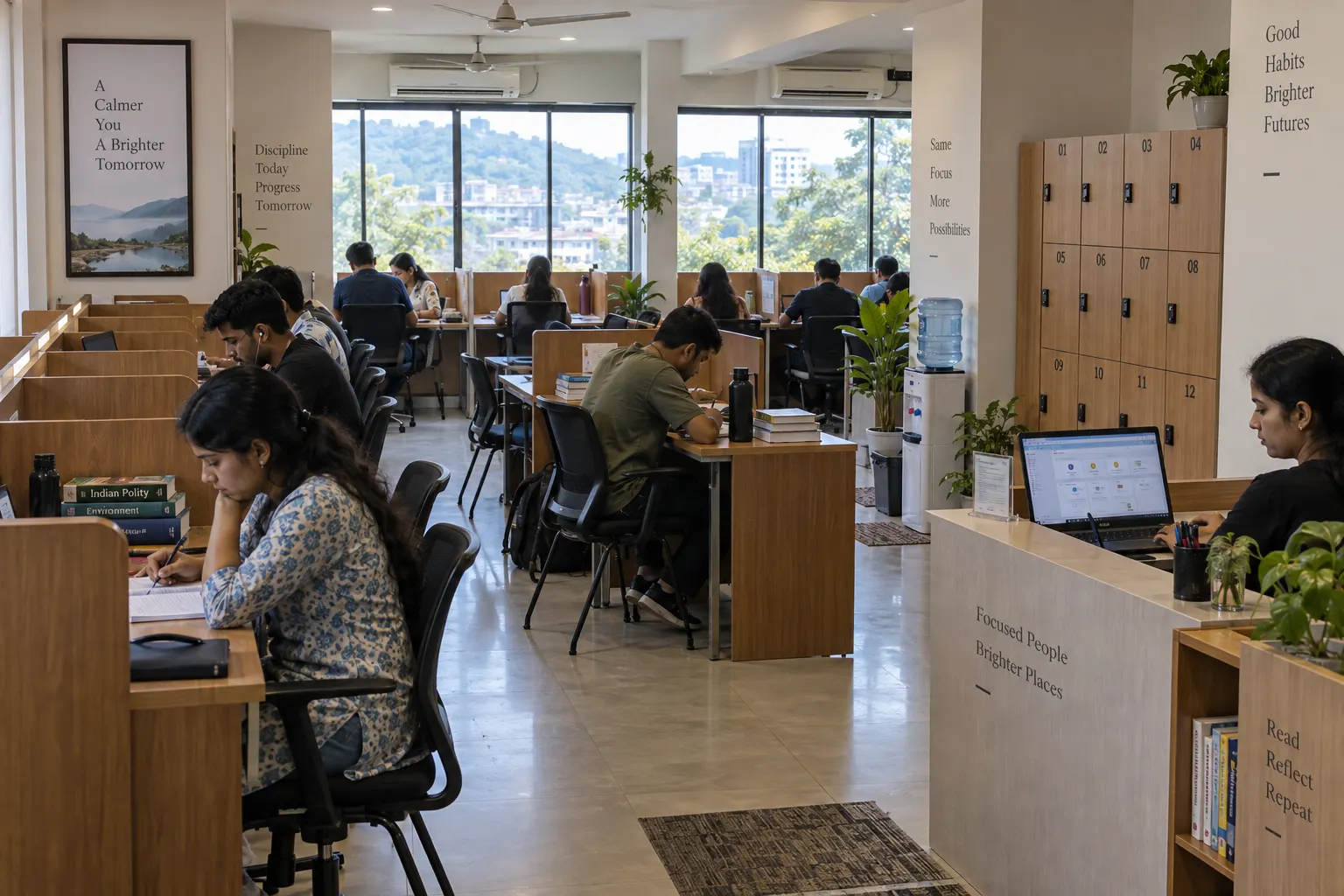
Central aspirant branch
APSC/UPSC and coaching-linked self-study context.
LIBIX FOR GUWAHATI STUDY LIBRARIES
Manage memberships, seats, study shifts, fees, attendance, renewals and branch operations from one system built for paid study libraries and reading rooms.
From Chandmari and Guwahati Club to RG Baruah Road, GS Road, Six Mile and Beltola, Libix helps study-library operators keep different access patterns and branch-level capacity understandable.

Guwahati study-library context; no specific local business is represented.
Distributed access patterns
A central aspirant branch, a 24×7 reading-room branch, a neighbourhood branch and a working-learner pattern may all operate under one business while serving different windows and member mixes.
APSC/UPSC and coaching-linked self-study context.
A wider daily access window without infinite capacity.
Recurring members who prioritize proximity to home.
Early-morning, evening or late-access routines.
Local operating context
These localities are geographic context examples, not a ranking and not claims that every branch or library follows the same pattern.
A central aspirant corridor where APSC, UPSC and Assam-recruitment routines can create long-day and extended self-study patterns.
Dense paid self-study activity may include time-slot or reserved-seat arrangements, individual setups and working learners.
Neighbourhood membership demand can create branch-level differences in access patterns, long-hour use and recurring study routines.
Branch-level capacity
A branch with 120 active members and 60 seats is not automatically under more pressure than one with 90 members and 60 seats. Window distribution, allocations and actual attendance change the operational picture.
Guwahati Branch × Access-Window Capacity Matrix
Use up to three fictional branches to compare simplified access windows. Extended members affect multiple windows through an explanatory weight; this is not live occupancy.
Highest current allocation load
Branch B · 80%
Allocated seats ÷ usable seats; not live occupancy.
Highest simplified pressure
Branch B · Daytime
52% of usable seats by this model.
Branch A window view
Early morning
34%
Daytime
45%
Evening
39%
Late night / overnight
26%
Branch B window view
Early morning
27%
Daytime
52%
Evening
40%
Late night / overnight
22%
Branch C window view
Early morning
27%
Daytime
40%
Evening
33%
Late night / overnight
20%
This matrix uses simplified access windows to compare branch-level capacity. It does not measure live occupancy, predict demand, rank neighbourhoods or recommend branch locations. Actual capacity depends on your membership plans, shift rules, seat allocations, operating hours, attendance and member behaviour.
Libix provides the membership, branch, seat, shift, attendance, renewal and collection records that help authorized staff review each location using its actual operating rules.
A branch is more than a name attached to a seat count. Keep memberships, seats, allocations, shifts, attendance, renewals and collections connected.
24×7 access creates more operating windows, not infinite capacity. Opening hours do not automatically grant every member unrestricted access.
Attendance gives each location an actual-use signal that can be compared with the applicable membership and access-window arrangement.
Upcoming renewals may change a branch’s capacity picture; review them alongside allocations and attendance.
Receipts, payments and outstanding dues should follow supported collection workflows rather than inferred branch pressure.
Use consistent records to review locations without assuming that all branches have identical demand patterns or member access.
Guwahati Multi-Branch Study Operations Board
The values below are synthetic and anonymized. They illustrate branch-aware membership, seat, attendance, renewal and dues review—not live Guwahati data.
Active memberships
236
Usable seats
185
Allocated seats
139
Today's attendance
112
Access windows
4
Renewals due
17
Outstanding dues
11
Branches
3
Six operational priorities
Memberships, branches, seats, access windows, attendance, renewals, dues and reports should remain reviewable as the operating footprint expands.
Memberships & branches
Seats & allocations
Study shifts & access windows
Attendance & history
Renewals
Fees, collections & reports
Controlled growth
Compare actual branch records before changing plans or shifts. Do not turn a simplified matrix into a location recommendation or demand forecast.
Guwahati FAQ
It helps paid reading rooms and self-study centres manage members, memberships, seats, shifts, fees, attendance, renewals and related operations.
Yes. Libix is intended for paid study libraries and reading rooms that need structured membership, seat, shift, attendance, renewal and collection records.
Yes. Libix manages the study-space operation rather than coaching or exam preparation. Supported workflows can serve adult APSC, UPSC, Assam-government, SSC, banking, railway, NEET and university learners.
It is a page-level planning model for comparing simplified seat and access-window pressure across up to three fictional branches. It does not measure live occupancy or forecast demand.
No. A branch can operate around the clock while still having seat limits, allocations, window-specific pressure and different membership arrangements.
No. Members can be distributed across early, daytime, evening and late-night windows. Membership count alone does not establish concurrent physical use.
Libix is designed around structured branch, seat and allocation records where those workflows are implemented. Confirm exact cross-branch behavior during evaluation.
Attendance is part of the study-library operating model and can provide an actual-use signal according to the implemented workflow.
Libix includes supported membership lifecycle, renewal, fee, collection, receipt and outstanding-amount workflows.
No. It does not rank neighbourhoods, recommend locations or forecast revenue or profitability.
Libix is intended to support structured multi-branch operations where the capability is implemented and configured.
The current CodePex commercial policy provides a six-month trial with premium features, subject to eligibility and onboarding terms.
Built for paid self-study operations
Evaluate Libix around the membership, seat, shift, attendance, renewal and collection workflows your study library actually needs.