
Software Evaluation · TCO · Commercial research
The Real Cost of Free Study Library Management Software
Count the costs that are required, incremental or economically attributable to a free software arrangement—while keeping optional, existing and hypothetical costs separate.
Quick answer
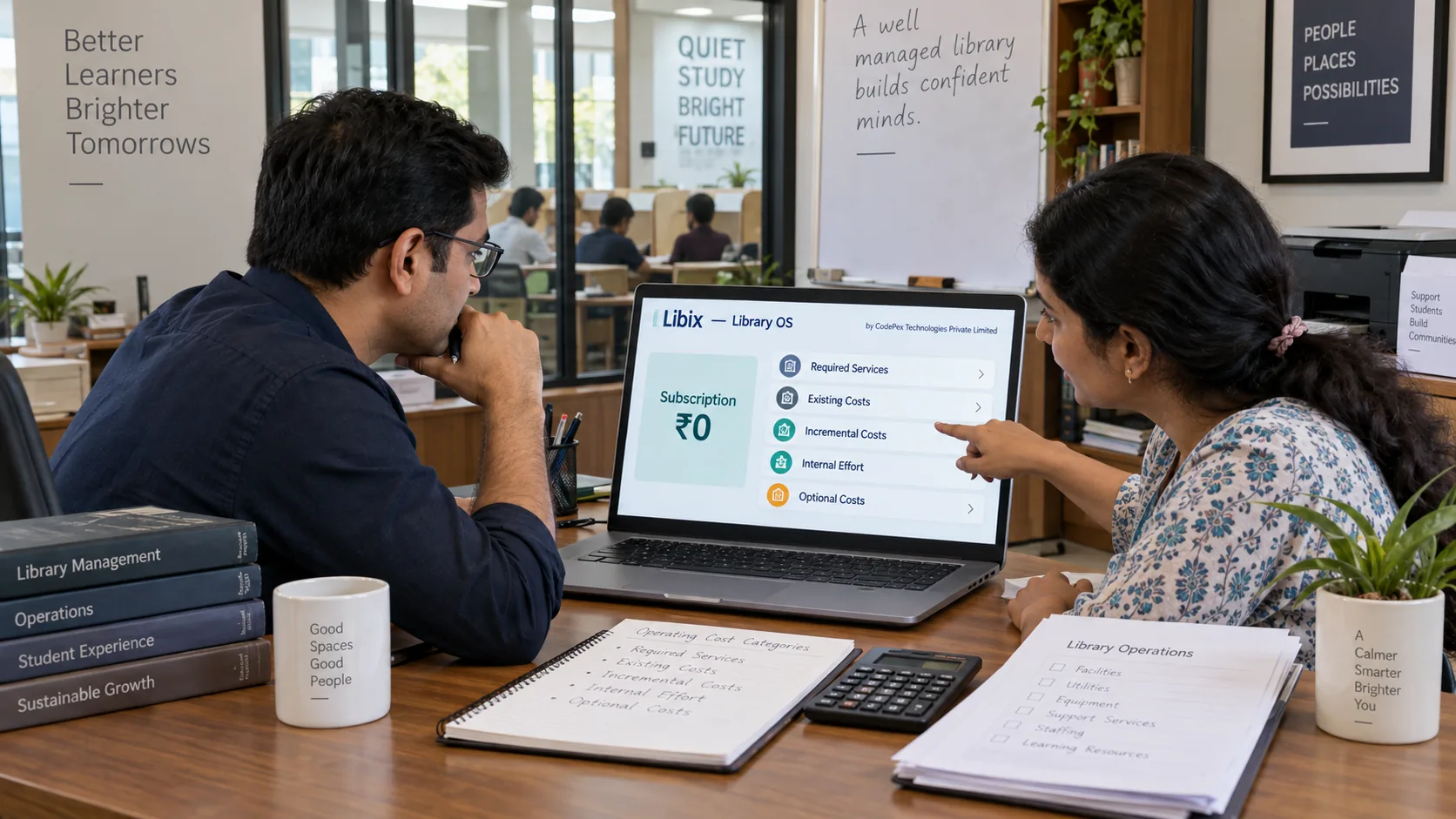
Free study-library software can have a ₹0 subscription price. Its relevant cost can also genuinely be ₹0 when existing resources remain unchanged, no required external services or new hardware are needed, incremental effort is negligible and the defined requirements are met. But ₹0 should not be assumed, and “free software always costs more” is equally unsupported.
Price is not cost
A ₹0 subscription is a price statement for one item. It does not automatically describe messaging, payment processing, hosting, implementation, migration, internal time, workarounds, upgrades or exit. Those may be required, optional, existing, incremental, uncertain or irrelevant to the defined decision.
Can the real cost actually be ₹0?
Consider a hypothetical one-branch owner who uses an existing laptop and internet connection, needs no paid messaging, handles payments outside the software, requires no migration or premium support, remains within the free plan, spends negligible incremental staff time and can export required data. For the defined horizon, the incremental relevant cost could be ₹0.
The purpose of TCO is accuracy, not persuasion. Do not manufacture hidden costs to prove a conclusion.
Define the decision and baseline
Write the question before collecting numbers: “What is the relevant cost of operating this arrangement for our current one-branch study library over the next 12 months?” Then compare with and without the decision. Existing broadband, a laptop or a printer belong to the baseline when the choice does not change their cost. If adoption requires a new device, count the incremental portion.
Incremental cost = Cost with the decision − Cost without the decision
For a fair comparison, use the same requirements, scope and time horizon for every alternative.
What belongs in the analysis?
Subscription and licence
Record a genuinely free subscription as ₹0. Do not invent an “effective” subscription to make the analysis non-zero.
Required add-ons and services
Include vendor modules, messaging, payment processing, hosting or integrations only when they are required for the defined scenario. Keep the charging party visible.
Adoption and implementation
Configuration, migration, data preparation, validation, training and onboarding may be one-time cash or internal effort. Self-service can be ₹0 if it truly requires negligible incremental work.
Infrastructure and hardware
Count only new or incremental hardware, networking, storage, printer, scanner or other infrastructure caused by the decision. Existing equipment is not automatically a software cost.
Internal staff and owner time
Track hours separately from cash. Give them a monetary value only when the owner explicitly chooses an assumption; time does not automatically become a cash expense.
Workarounds and controls
A workaround may consume recurring hours, create reconciliation work or increase review effort. Model the attributable difference carefully; a possible error is not a proven loss.
Upgrade triggers
Model an upgrade only in a scenario where a future requirement actually makes it necessary. Do not assume a plan limit is a cost until it creates an economic consequence.
Switching and exit
Export, map, migrate, validate, retrain and parallel-run effort may matter at exit. Export availability does not mean zero migration effort, and switching cost is not automatically vendor lock-in.
Workarounds and error scenarios need discipline
Manual work is not automatically a financial loss. If a software limitation creates recurring additional hours, missed reconciliation, duplicate entry or an evidenced correction burden, model only the attributable difference. Use owner-entered frequency and consequence assumptions. Label estimated error cost as a scenario—not historical proof. The alternative may have workarounds too.

Use the same horizon and test scenarios
Choose a period such as 12, 24 or 36 months based on the decision. Separate a base case from a growth case and an exit-inclusive case. A future upgrade belongs only in the scenario where a defined requirement makes it necessary. Switching effort can include export, mapping, migration, validation, retraining and parallel running. Do not count a cost twice across categories.
Relevant cost and TCO formulas
Base cash relevant cost = required vendor cash + required third-party cash + required one-time cash + incremental infrastructure + required recurring cash.
Optional internal-resource value = incremental hours × owner-entered hourly value, only when explicitly enabled.
TCO is a cost view over a defined horizon. It is not ROI, revenue, savings or a benefit claim.
Compare free and paid arrangements fairly
Use the same business scope, requirements, horizon, internal-time treatment, external services, migration assumptions, support expectations, export needs and growth scenario. Common costs may cancel out in a differential comparison. Paid software may have implementation and switching costs; free software may have them too. Neither price label proves the better choice.
Interactive relevant-cost calculator
Model your own assumptions, not a universal hidden cost
Every amount starts at zero and must be supplied by you. Separate existing unchanged costs from incremental costs before entering them. This calculator produces cost scenarios only—not ROI, savings, profit or a recommendation.
A practical cost worksheet
Where Libix fits
Keep Libix in the same neutral comparison
Libix — Library OS is positioned for private study-library operations. Current pricing, free or paid terms, evaluation conditions, included capabilities, limits, support, implementation, migration, messaging, payment relationships, taxes and renewal terms must be verified from current approved commercial documentation before entering them into a comparison. This page does not assume Libix is the cheapest or most expensive option.
Frequently asked questions
Can the relevant cost of free software really be ₹0?
Yes. If the subscription is ₹0, existing resources remain unchanged, no required external services or new hardware are needed, incremental effort is negligible for the defined horizon, and the required data can be exported, the incremental relevant cost may genuinely be ₹0.
What is the difference between price and cost?
Price is what a provider charges for a defined item. Cost is the relevant cash and resource impact of the decision after baseline, required services, incremental effort, workarounds, growth and exit assumptions are considered.
Should existing internet and computers be counted as software costs?
Not automatically. If they already exist and the software decision does not change their cost, they belong to the baseline rather than incremental software cost.
Is lower TCO always the better choice?
No. Lower cost can come with an unsuitable workflow, weak control, poor portability or unacceptable service. Compare equivalent requirements and evaluate benefits and risk separately.