
Business · Master pillar · India
The Complete Study Library Business Guide for India
A navigable map of the complete business lifecycle—from local demand and investment through location, capacity, pricing, operations, finance, retention, technology, owner independence and responsible growth.

Quick answer
A study-library business aligns local demand, location, capacity, pricing, member experience, operating discipline, financial control, reliable records, continuous improvement and responsible growth. Seats alone do not make a durable business.
Demand
Know who may use the service, why they would pay and what local evidence supports the assumption.
Economics
Model pricing, capacity, costs, collections, working capital and uncertainty.
Experience
Deliver quiet, comfortable, reliable and understandable service members consider worth renewing.
Operations
Run admissions, memberships, seats, attendance, fees, renewals, complaints and facilities consistently.
Control
Preserve financial records, responsibilities, reporting, corrections, permissions and management discipline.
What is a study-library business?
It is a paid study environment, commonly serving students and competitive-exam aspirants who value a dependable place to concentrate. It is not the same as a traditional book-lending library, coaching institute or coworking space. The business promise is an operating relationship: access, environment, service, records, payments, renewals and trust.
The complete business lifecycle
Use this page as the master map. Each phase should result in a decision, evidence, dependency or next question—not just activity.
1. Understand the market
Study the local catchment, competing alternatives, access, neighbourhood, demand signals and unanswered questions. India is heterogeneous; a result in one city or area is not a national formula.
2. Define the customer
Describe the member groups you intend to serve without assuming they have identical schedules, budgets, exam routines or service preferences.
3. Validate demand
Test whether people will actually enquire, compare, visit and pay under a defined service proposition before committing substantial capital.
4. Choose the business model
Decide paid access, plans, duration, seats, shifts, included services, staffing, owner role and operating hours.
5. Estimate investment
Separate setup investment, deposits, furniture, technology, launch costs, working capital and recurring obligations.
6. Select location
Evaluate access, catchment, noise, property terms, utilities, safety, premises suitability and total cost.
7. Design capacity
Plan usable seats, layout, circulation, charging, storage, zones, shifts and serviceable capacity—not just maximum furniture count.
8. Model economics
Keep revenue, collections, costs, profit, cash flow, occupancy and break-even definitions distinct. Use explicit assumptions.
9. Define memberships and pricing
Create understandable plans, price history, concessions, freezes, extensions, cancellations, refunds and effective dates.
10. Verify requirements and policies
Check the local, premises, tax, safety, employment, privacy and other requirements that apply. This guide is not legal or tax advice.
11. Prepare the facility
Make desks, lighting, cooling, power, internet, washrooms, cleaning, access, storage and signage reliable.
12. Build operating processes
Document enquiry, admission, membership, allocation, attendance, payment, receipt, dues, renewal, complaint, opening, closing and incident workflows.
13. Market locally
Explain the service accurately, capture enquiries consistently and avoid unsupported exam-success promises.
14. Handle enquiries and admissions
Use one path from enquiry through plan explanation, availability, registration, allocation, charge, payment, receipt, rules and activation.
15. Manage seats, shifts and attendance
Separate seat identity, allocation and recorded attendance. Define access windows and exceptions.
16. Control revenue workflows
Distinguish charge, payment, receipt, allocation, due, refund, reversal, cash close and reconciliation.
17. Build renewals and retention
Treat expiry, reminder, service context, renewal, extension, freeze and non-renewal as an explicit lifecycle.
18. Manage member experience
Make the daily experience predictable while preserving human judgment, feedback and complaint resolution.
19. Staff, SOPs and facilities
Give roles clear boundaries, train people on normal work and exceptions, and maintain the premises with evidence.
20. Establish financial control
Review collections, expenses, cash, digital settlements, vendors, corrections and reconciliations. Revenue is not profit; profit is not cash flow.
21. Use KPIs and reviews
Define active members, renewals, dues, collections, costs, capacity, service and exceptions before comparing them.
22. Introduce technology carefully
Connect real processes when the need is clear. Automation supports management; it does not create management automatically.
23. Reduce owner dependency
Move routine work into roles, permissions, SOPs, evidence, backups and exception reporting while retaining owner governance.
24. Build for scale
Professionalize before multiplying. Check whether processes, records, service and economics can be repeated without proportional chaos.
25. Evaluate multi-branch growth
Separate branch execution from organization-wide truth, access, reporting, controls and governance. Opening another branch is not the definition of growth.
Common business mistakes
A 90-day pre-opening framework
Validate
Customer, market, location questions
Model
Investment, costs, pricing, capacity
Build
Facility, plans, policies, processes
Test
Staff, payments, receipts, allocation, exceptions
Launch
Readiness review, controlled opening, early review
This is a planning structure, not a universal deadline.
For an existing owner
Map the current reality before trying to improve it: actual members and memberships, usable capacity, plans and prices, attendance context, collections and dues, renewals, expenses, staff responsibilities, complaints, owner interruptions, data sources and recurring exceptions. Then choose one constraint to improve and measure its definition consistently.
Where Libix fits
Connect the operating system to the business map
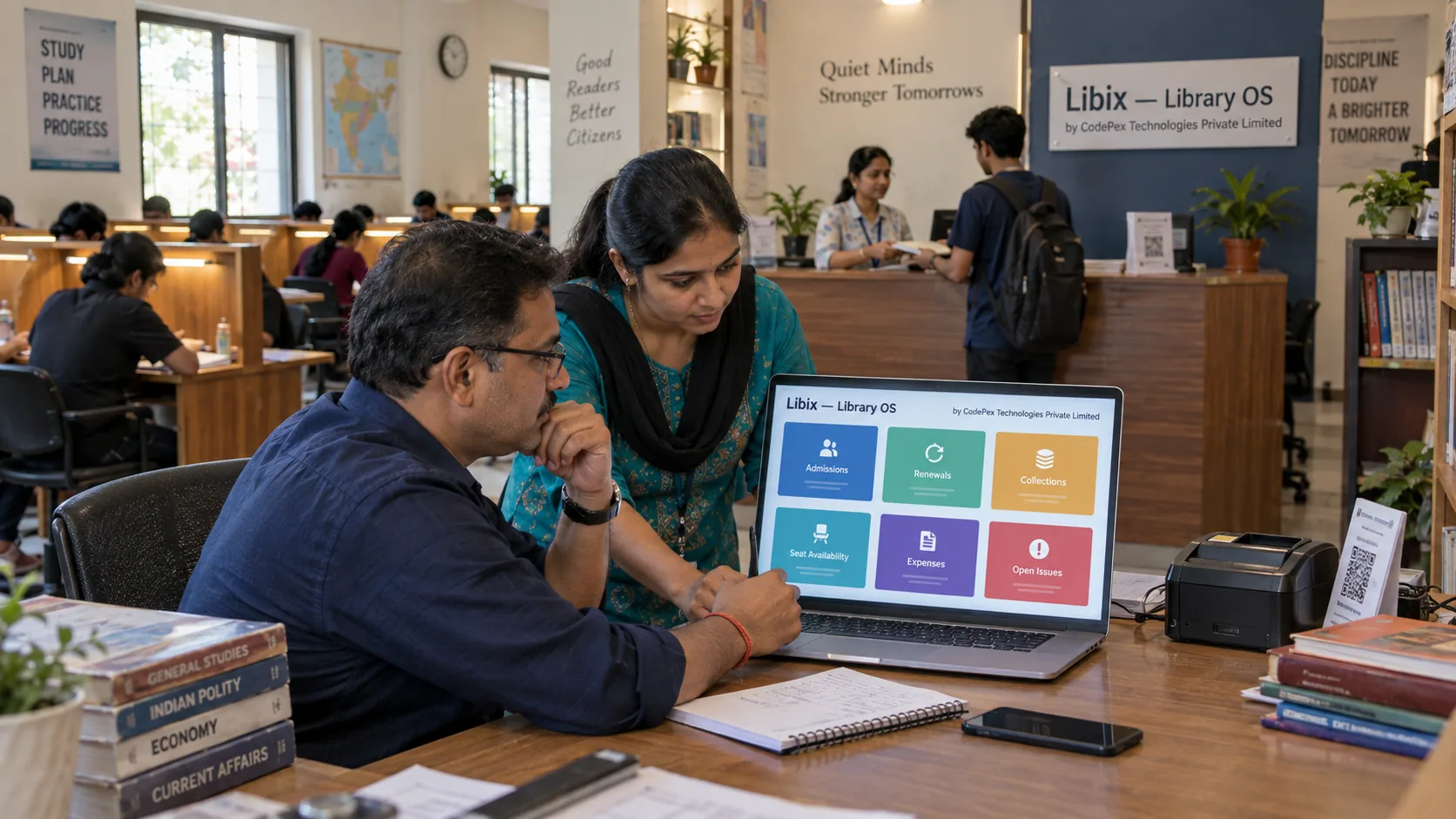
Libix is positioned around study-library workflows such as members, memberships, plans, seats, shifts, attendance, fees, payments, receipts, renewals, staff, expenses, complaints, reports and branches. Specific current capabilities must be verified against approved product documentation and the current repository. Technology should connect real processes; it does not substitute for business strategy.
Interactive business map
Choose the next business question
This planner routes you to knowledge areas. It does not score business success, predict profitability or make an automatic Libix recommendation.
Business journey
Suggested next areas
- 1.Validate market and demand
- 2.Model investment and economics
- 3.Evaluate location and capacity
Pre-opening review
Checklist output, not a readiness percentage.
Missing review items: 9
Illustrative assumption worksheet
Illustrative revenue
₹54,000
Illustrative costs
₹1,15,000
Entered investment
₹5,00,000
Illustrative model based on your inputs; not an industry benchmark or forecast.
Frequently asked questions
What is a study-library business?
It provides a paid, dedicated environment where students and competitive-exam aspirants can study with greater consistency, comfort and discipline than may be possible in other environments.
Is a study-library business profitable in India?
Profitability depends on local demand, pricing, capacity, occupancy, costs, collections, renewals and operating discipline. There is no single India-wide answer.
How much investment is needed?
Build an assumption-based model covering property, setup, furniture, utilities, technology, launch costs, deposits and working capital. Avoid treating an example as an industry average.
How many seats should I start with?
Capacity should follow validated demand, usable space, member expectations, cost structure and operating ability—not a universal seat count.
Do I need study-library software?
Not automatically. Evaluate software when connected records, permissions, history, reporting or recurring coordination work create a defined need.
When should I open another branch?
Only after the first operation has credible demand, controlled economics, repeatable processes, staff capability, useful reporting and a reasoned expansion case.