
Commercial-model taxonomy
Open-Source vs Freemium vs Free-Trial Study Library Software
These models describe different dimensions of access. Compare rights, hosting, duration, scope, responsibility, support, data, cost and exit—not the word “free” alone.
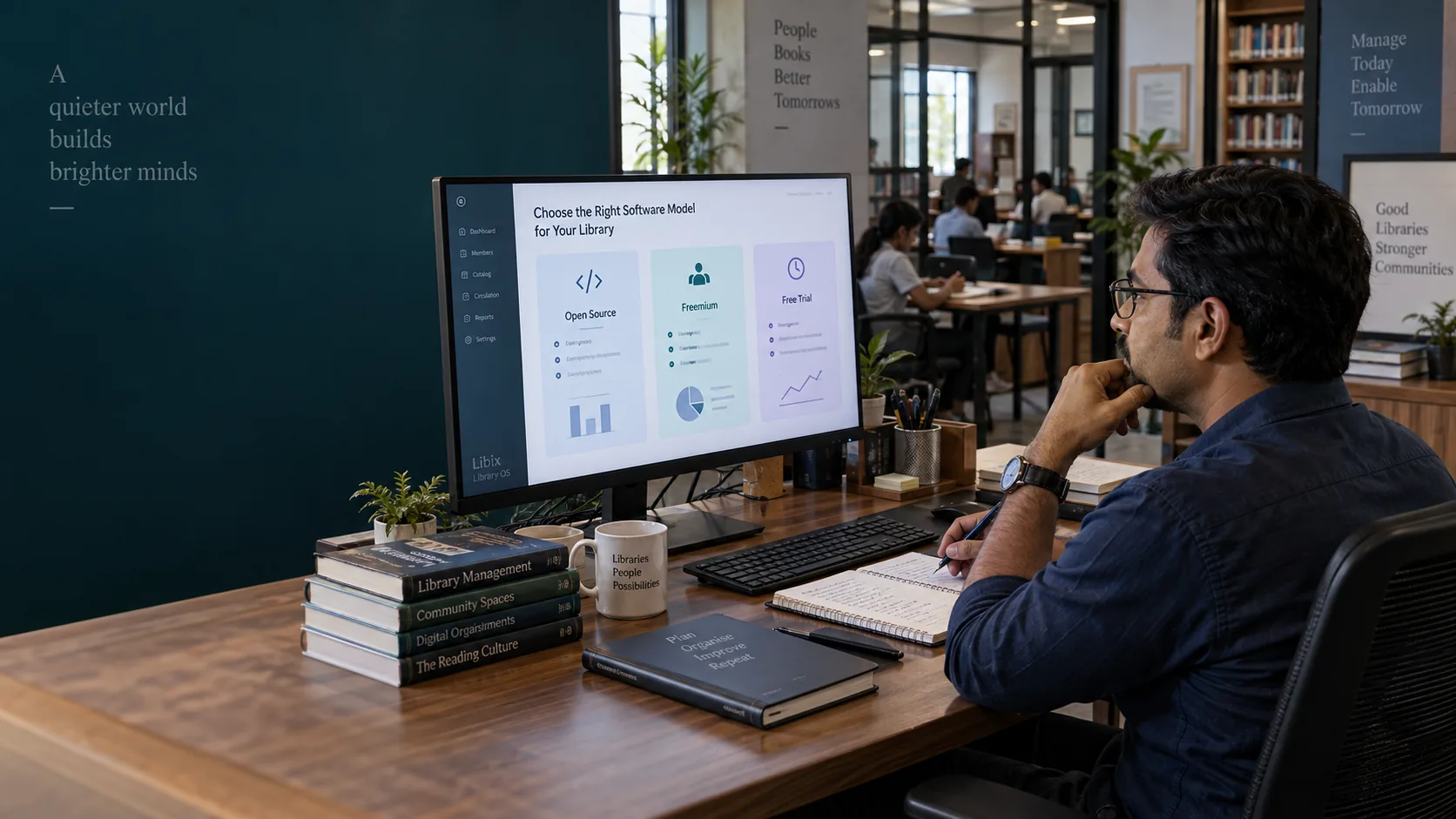
Governing principle
Open source, freemium and free trial describe different dimensions of software access. Verify the actual rights, responsibilities, terms and exit path.
Quick answer
Open source, freemium and free trial are not three versions of “free”
Open source primarily concerns licence rights around source code. Freemium primarily describes a commercial model with a usable zero-price tier alongside paid options. Free trial primarily describes temporary or evaluation-limited access before a commercial decision.
Open source
Ask what the licence permits, who hosts, who maintains and what support is available.
Freemium
Ask whether the free tier covers the workflows, capacity and continuity your operation requires.
Free trial
Ask what can be proven before the access period ends and what happens to data afterward.
Why the models are confused
All three can allow software use without an immediate full paid subscription. But open-source software can be paid, open-source software can be commercially hosted, proprietary software can have a permanent free tier, and a trial can include broad capabilities. A freemium tier can also remain sufficient for some organizations.
The three core definitions
Open-source software
Software distributed under a licence granting specified rights to access source code and use, inspect, modify and/or redistribute it according to that licence. The exact rights and obligations depend on the actual licence.
Freemium software
A commercial model in which a usable zero-price tier exists while additional capabilities, capacity, service or other value may be offered through paid tiers or add-ons.
Free trial
A time-limited or otherwise evaluation-limited opportunity to use software before deciding whether to enter a paid arrangement, stop using it or choose another option.
These dimensions can overlap. A product can have an open-source component and paid hosting, or a proprietary product can have both a free tier and a trial. Classify each dimension separately.
Open source: rights first, deployment second
Open source is primarily a licence question. Inspect which licence applies and what rights it grants. It is not a promise of zero price, self-hosting, community-only support, automatic security or no vendor.
Licence ≠ hosting
Open-source software may be self-hosted, hosted by a partner, commercially hosted or deployed in an owner-controlled cloud account.
Source available ≠ open source
Code visibility under restrictive or unusual terms may not provide recognized open-source rights. Read the actual licence; this page is not legal advice.
Paid open source is possible
Hosting, implementation, support, customization or managed services may be paid even when licence acquisition is zero-price.
Source access ≠ portability
Access to code does not automatically provide a clean export of members, memberships, payments, receipts, seats, attendance and history.
Freemium: a commercial tiering model
A freemium product offers a usable zero-price tier while additional value may be available through higher capacity, advanced capabilities, more users or branches, integrations, support, automation or paid add-ons. A free tier can be sufficient for some organizations and insufficient for others.
Freemium ≠ demo
A free tier is intended to provide some continuing use under current terms. A demo is a presentation or limited experience and may not be an operating plan.
Freemium ≠ forced upgrade
Some organizations may remain within the free tier. Verify what triggers an upgrade rather than assuming every free user must convert.
Free trial: an evaluation mechanism
A trial gives prospective customers temporary or otherwise limited access before they subscribe, purchase, stop or choose another product. Scope, duration, support, data retention and conversion behavior depend on current terms.
Trial duration ≠ evaluation quality. Use the period to test real admissions, memberships, fees, receipts, seats, shifts, attendance, renewals, permissions, reports, exports and exceptions—not just a polished demonstration path.
Master comparison
| Dimension | Open source | Freemium | Free trial |
|---|---|---|---|
| Primary concept | Licence and source-code rights | Commercial zero-price tier with paid paths | Temporary or evaluation-limited access |
| Must be zero-price? | No | Free tier is zero-price under terms | Trial access may have no subscription charge under terms |
| Permanent use? | Depends on licence and deployment | May continue under current terms | Usually limited by duration or condition |
| Source rights | Defined by licence | Unrelated to freemium status | Unrelated to trial status |
| Hosting | Self, partner or vendor depending on deployment | Product-defined | Product-defined |
| Paid path | Hosting, support or services may be paid | Premium tiers or add-ons | Subscription or purchase after trial |
| Main question | What rights and responsibilities do we have? | Does the free tier do enough? | Can we prove fit before access ends? |
Compare responsibilities, not just access
For each option, record who operates servers and databases, manages SSL and deployment, applies updates, monitors infrastructure, creates backups, tests restores, handles security responsibilities, answers support requests and maintains integrations.
| Evidence area | Questions | Evidence to retain |
|---|---|---|
| Licence and rights | Which licence applies? Can code be used, modified or redistributed? | Actual licence text and authoritative evidence |
| Hosting | Who operates servers, database, deployment and infrastructure? | Deployment terms and responsibility map |
| Duration | Is use ongoing or evaluation-limited? What changes at the end? | Current plan/trial terms |
| Scope and limits | Are members, users, branches, payments, reports and exports included? | Workflow test and documented limits |
| Support and updates | Who answers questions, applies updates and handles compatibility? | Support and maintenance terms |
| Data and exit | Can operational history and relationships be exported and used? | Test export and exit process |
| Commercial path | What paid services, tiers, conversion or external costs apply? | Written commercial terms |
Security, updates, backup and support
No model is automatically secure or insecure. Source-code access is not a security guarantee, and closed source is not automatically insecure. Security depends on design, implementation, deployment, maintenance, credentials, network controls, database access, monitoring and response.
Updates and maintenance
Ask who publishes and applies updates, whether database migrations are involved, how compatibility is checked and what happens after failure.
Backup is not export
Ask who creates backups, how restore is tested and how long records remain recoverable. Separately verify whether useful operational data can be exported.
Support is a spectrum
Community, documentation, vendor, commercial support and implementation partners are different arrangements. Community support ≠ no support.
Managed vs self-managed
Do not assume the owner personally operates a self-hosted system. A chosen technical provider may do so; record responsibility explicitly.
Verify workflow scope and capacity
Use the same requirement list for every model: members, memberships, seats, shifts, users, branches, payments, receipts, reports, exports, automation, integrations and historical data. Record whether each requirement is included, limited, optional, supported by an external service or unverified.
Price is only one dimension
For each model, record licence or subscription, required hosting, implementation, support, updates, integrations, infrastructure, internal effort and exit costs. Do not infer total cost from the label “open source”, “freemium” or “trial”. For detailed total-cost analysis, see Is Free Study Library Software Really Free? and Study Library Management Software Cost.
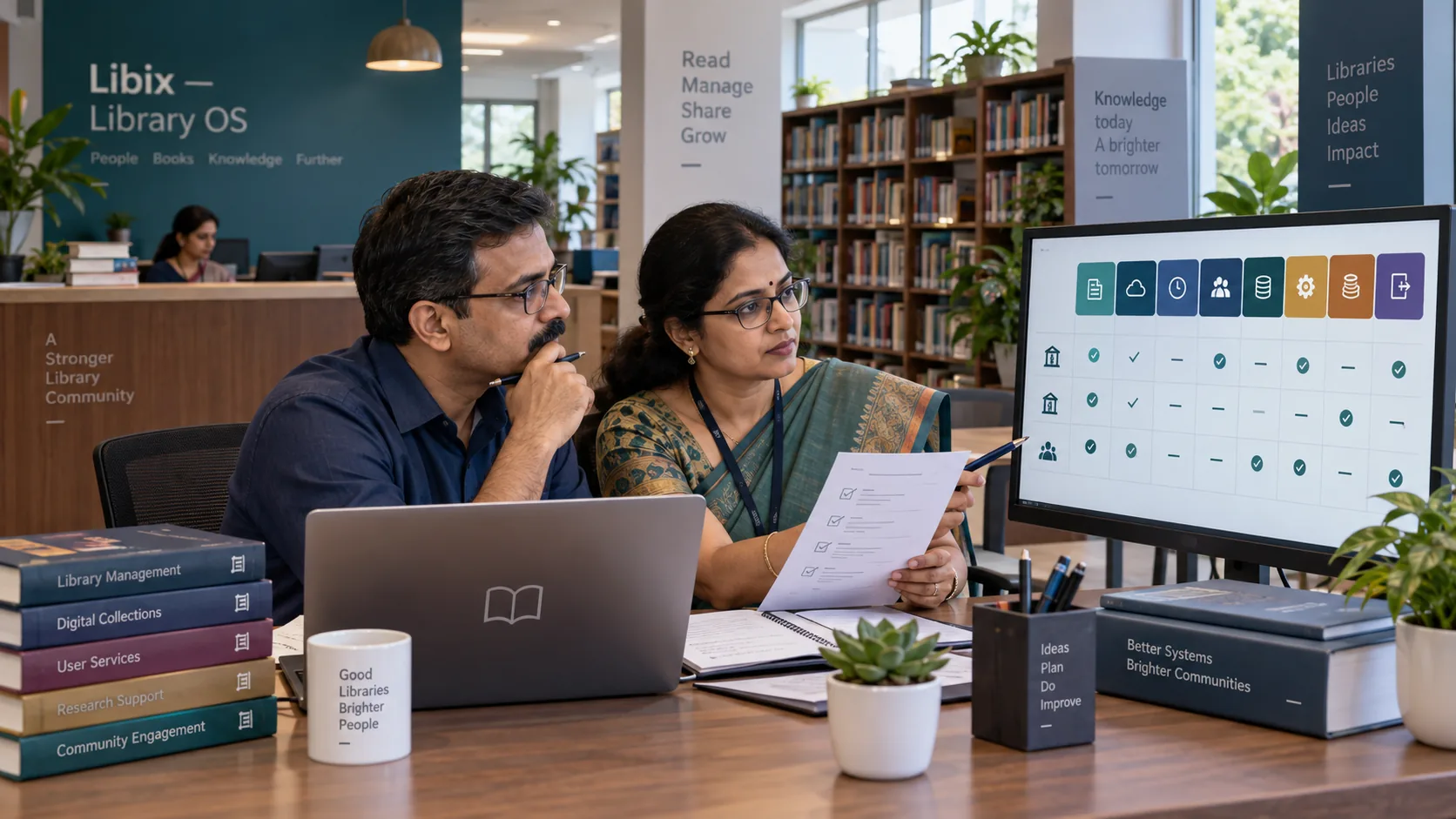
Five hypothetical scenarios
The new owner
A trial may help test real workflows before a long-term decision, but export and end terms must be understood.
The technical operator
Open-source options may deserve deeper evaluation, but technical ability does not compensate for weak operational fit.
The low-administration owner
Managed SaaS may fit; hosted open source may also fit. Compare responsibility, support and continuity.
The multi-branch operator
Branch architecture, permissions, consolidated reporting, support and portability matter more than the model label.
The permanent-free question
Freemium asks whether the current tier can run the business; a trial asks whether fit can be proven before access ends.
Interactive worksheet
Which software model are you evaluating?
Use the explorer to structure evidence. It does not make a legal determination, rank products, predict cost, recommend Libix or assign a quality/security score.
Client-side model explorer
Which software model are you evaluating?
This is an educational classification aid, not a legal determination or product recommendation. The actual licence and terms control.
Interpretation
Insufficient Evidence
Important model, responsibility or exit questions remain unresolved. Verify the actual licence or terms before classifying the offer.
Unresolved areas: Is source code accessible? · Is the actual licence identified? · Are modification and redistribution rights understood? · Is there a zero-price tier or access path? · and others
No answers are persisted, sent to a backend or used to recommend Libix. Model type does not determine quality, security, fit or cost.
Decision matrix
Source-code rights
Investigate open-source options and verify the actual licence, rights and obligations.
Ongoing zero-price tier
Investigate freemium options and verify current free-tier scope, limits and change terms.
Deep pre-purchase evaluation
Investigate trials and verify scope, duration, support, export and post-trial behavior.
Minimal technical administration
Investigate managed offerings and verify hosting, support, backup, update and recovery responsibility.
Easy exit or growth
For any model, verify operational export, history, relationships, capacity, support and migration path.
This is a research map, not a ranking. Any model can be suitable or unsuitable for a specific operation.
Verification checklist
For each important claim, mark it Proven, Partially Proven, Unverified, Not Supported or Not Applicable.
Where Libix fits
Apply the same tests to Libix
Libix — Library OS, developed by CodePex Technologies Private Limited, is intended for private study libraries, reading rooms and related self-study operations. This page does not classify Libix as open source, freemium, free forever or free trial.
Verify the current licensing and commercial model, evaluation duration, included capabilities, usage limits, support, pricing, post-evaluation conversion and data/export conditions immediately before publication or purchase. Preserve the distinction between Implemented ≠ Planned ≠ Architectural.
For adjacent guidance, read Free vs Paid Study Library Software, How to Choose Study Library Management Software and Experience the Complete Product Before You Decide.
Frequently asked questions
Is open-source study-library software always free?
No. Open source primarily concerns licence rights. Hosting, support, implementation, customization or managed services may be paid.
Does open source always mean self-hosted?
No. Open-source software may be self-hosted, hosted by a partner, commercially hosted or deployed in an owner-controlled cloud account.
Is source-available software the same as open source?
Not necessarily. The actual licence determines the rights granted. Source visibility alone is not enough to classify the software as open source.
Is freemium the same as a free trial?
No. Freemium normally provides an ongoing zero-price tier under current terms; a free trial is temporary or otherwise evaluation-limited.
Can a freemium plan be sufficient permanently?
Yes, if its current scope, limits and conditions continue to satisfy the operation’s requirements. Verify terms rather than assuming permanence.
Does a long trial prove that software is better?
No. Duration provides evaluation time, not proof of workflow fit, reliability, security, support or business suitability.
How should Libix be classified?
Only according to current verified licensing and commercial terms. Do not call Libix open source, freemium or free forever without factual and contractual evidence.