
Owner Problems · Attendance · System choice
Manual vs Digital Attendance for Study Libraries: Which System Should You Use?
Compare registers and structured digital records by evidence, corrections, reporting, privacy, outages, cost and scale—without assuming technology alone creates accuracy.
Quick answer
A small, simple library with disciplined staff may be able to use a manual register. As members, shifts, branches, hours, seat allocations, correction needs and reporting complexity grow, structured digital records may provide stronger control. Neither model eliminates errors. Compare the actual operating process, failure modes, privacy, outage plan, cost and evidence requirements before choosing.
Manual ≠ automatically inaccurate · digital ≠ automatically accurate · attendance ≠ entitlement, allocation or occupancy by default.
Define attendance and its capture method
Attendance is a record of presence under a defined model, with member, branch, time and context. Manual attendance may use a paper register, staff mark or spreadsheet. Digital attendance stores structured events. Capture may be staff-assisted, member self-service, QR, a supported credential or hardware. The system governs identity, validation, correction, history and reporting; the capture method is only how the event begins.
Manual versus digital comparison
| Dimension | Manual | Digital |
|---|---|---|
| Setup | Usually simple, low technology dependence. | Requires configuration, training and infrastructure. |
| Search/reporting | Becomes manual as records grow. | Structured records can support faster aggregation. |
| Corrections | Written changes depend on discipline. | Can use controlled workflow and audit when implemented. |
| Branches/shifts | Visibility and consistency require manual work. | Can be structured, but configuration and permissions matter. |
| Outages | Technology dependence is low. | Needs verified degraded-mode and reconciliation plan. |
| Errors | Missed or ambiguous marks remain possible. | Wrong-member, duplicate, device and sync errors remain possible. |
Evaluate evidence and failure modes
Manual records can be careful, timely and sufficient for a simple operation, but exposed registers, inconsistent handwriting, missed marks, delayed reconciliation and limited search may matter. Digital records can improve structure and reporting, but devices, network, identity selection, duplicate requests, configuration and privacy access can fail. Corrections in either model should be authorized and traceable where practical.
Keep attendance separate from other records
Attendance does not automatically prove continuous presence, membership entitlement, seat allocation or occupancy. A check-in can contribute to occupancy only under a defined methodology. QR and biometrics are capture options, not complete attendance systems; biometric use requires specialist privacy, security and legal assessment. Staff-assisted digital entry is still digital capture.
Attendance decision lab
Compare total operating effort
Enter hypothetical scenario costs. This does not invent wages, software prices, accuracy, savings or ROI; it makes the assumptions visible for a local decision.
Manual scenario total
₹18
Recording + reconciliation assumptions
Digital scenario total
₹6,000
System + infrastructure assumptions
Include training, corrections, outage handling, reporting effort, privacy controls and implementation work before making a decision.

Account for shifts, branches and 24/7 operations
Multiple shifts, branches, cross-midnight operation, seat allocation and access rules increase the need for consistent context. Digital structure can help central visibility if the records, permissions and definitions are reliable. Do not assume a digital system handles overnight events, offline mode or branch access unless the implementation verifies it.
Plan outages and degraded operation
A digital process needs a documented device, network and system-outage fallback. If offline queueing exists, it must be verified; replayed events need duplicate protection and reconciliation. A fallback must not bypass authorization. Manual fallback during a digital outage should preserve source, time precision and later reconciliation without fabricating exact historical timestamps.
Protect privacy and access
Paper and digital attendance both create privacy exposure. Limit visible personal data, restrict digital history by role and branch, protect exports and apply retention policy. Do not collect biometric data merely to demonstrate a feature, and do not claim legal requirements without current authoritative verification.
Migrate deliberately
Use Define → Configure → Pilot → Compare → Correct → Train → Cut over → Monitor. Decide which system is authoritative during a time-bounded parallel run. Historical paper records should retain their provenance and precision; unknown time is not midnight, and missing checkout is not an invented checkout. Do not back-enter every old page unless the business purpose justifies the work.
When manual may still be sufficient
Manual attendance may remain reasonable when the operation is small and simple, records are consistently maintained, reporting needs are limited, corrections are controllable, branch/shift complexity is low and the privacy/technology tradeoff is understood. Digitization triggers include repeated search burden, multiple branches, more shifts, frequent corrections, 24/7 operation, reporting needs or inability to reconstruct history—not an arbitrary member count.
Where Libix fits
Libix — Library OS, from CodePex Technologies Private Limited
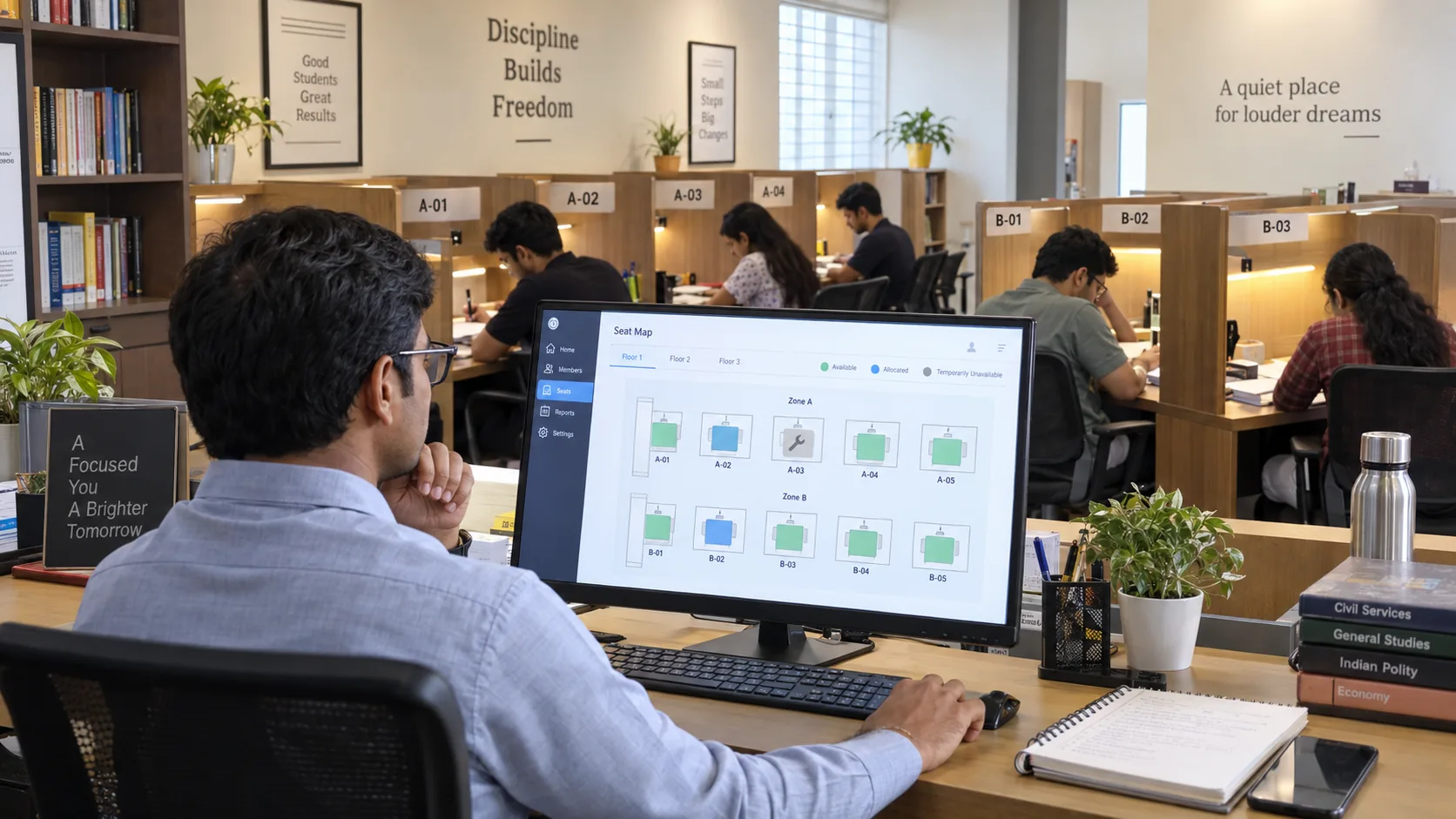
Libix is positioned for connected study-library operations around members, shifts, seats, allocations and attendance. Current capture methods, QR or biometric integrations, offline behavior, corrections, permissions, audit and reporting must be verified against approved documentation and the live implementation.
Explore Libix LearningAttendance-system decision checklist
Frequently asked questions
Is manual attendance automatically inaccurate?
No. A disciplined small operation can maintain useful manual records, although search, aggregation, corrections and multi-branch visibility may become harder as complexity grows.
Is digital attendance automatically accurate?
No. Digital systems can still have missed, duplicate, wrong-member, device, network and configuration errors. Accuracy depends on controls and operating discipline.
Is QR attendance the same as a digital attendance system?
No. QR is one possible capture method. The attendance system also includes identity, context, validation, correction, history and reporting.
Does check-in prove full-day presence?
No. Check-in records an event under the attendance model. Continuous presence requires defined session and checkout evidence.
When should a study library digitize attendance?
When search, shifts, branches, correction burden, reporting needs, auditability or operating hours justify structured digital records. There is no universal member-count threshold.