
Business · Industry outlook · Scenario planning
The Future of Study Libraries in India
A disciplined outlook on how physical study environments, professional operations, payments, capacity, data, automation, AI, privacy and resilience may evolve—without pretending to know one fixed future.
Quick answer
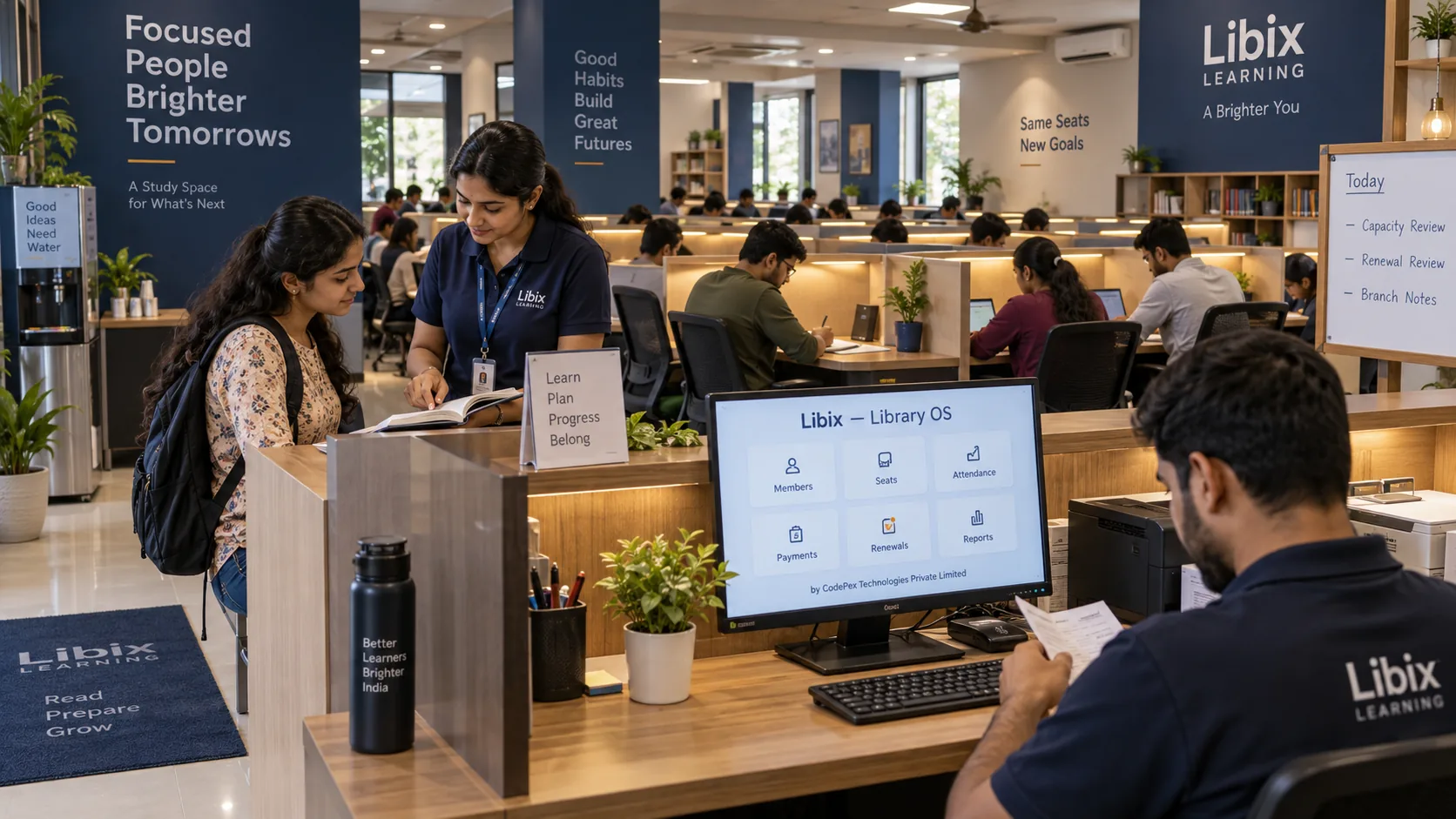
The future is unlikely to be determined by one technology or one business model. A more durable direction is the combination of a strong physical study environment, disciplined operations, digital records, financial control, member understanding, adaptable capacity, responsible data use and technology that can evolve without disrupting the business.
A future scenario is not a prediction. National digital growth is not a study-library market forecast, and technology adoption is not business success.
What can—and cannot—be predicted
Current context can show a large student environment, connectivity, digital-payment infrastructure, a formal data-protection framework and fast-moving technology. It cannot tell us the future number of study libraries, revenue, occupancy, member preference, software adoption, AI adoption, franchise count or the winning seating model. Local demand, pricing tolerance, competition, safety, transport and service quality still need local validation.
Why physical study spaces may remain relevant
Online learning changes access to content. It does not automatically provide a quiet desk, reliable electricity, internet, comfortable seating, long uninterrupted time, household separation or a repeatable study routine. A paid study library is not simply a traditional book-lending library; it can be a managed physical environment for focused self-study. Digital learning and physical study space can therefore coexist.
India context without false market sizing
The Ministry of Education’s annual-report material and AISHE releases provide higher-education context; TRAI publishes current telecom subscription reports; RBI describes India’s digital-payment evolution; and MeitY publishes DPDP materials. These sources help describe the environment in which study-library businesses operate. They do not measure paid study-library demand or establish a forecast for this niche.
Twenty forces worth watching
Professionalisation
Owners may increasingly manage admissions, memberships, pricing, receipts, renewals, staff, service and financial closing as one business system.
Member experience
Cleanliness, quiet, lighting, rules, facilities, fair seat treatment, transparent fees, receipts and complaint handling remain part of the value.
Connected operations
Registers can become connected records for members, memberships, seats, shifts, attendance, charges, payments, receipts and renewals.
Digital payments and finance
A digital payment still needs charge identity, receipt, settlement, dues, refunds, reversals and reconciliation. Convenience is not control.
Capacity intelligence
Seat, zone, time, shift, membership period, allocation and actual use should remain distinct before a capacity decision is made.
Fixed and flexible access
Different libraries may use fixed, flexible or hybrid models. No evidence supports saying one will eliminate the others.
Specialisation
Some operators may serve a clear exam, schedule or member segment; local willingness to pay and service needs still require validation.
Tier-2 and Tier-3 evaluation
Smaller cities may offer opportunities in some locations, but rent, transport, competition, safety, alternatives and pricing tolerance must be checked locally.
Multi-branch operations
Networks may emerge, but branch identity, permissions, staff, collections, local service and accountability make growth more complex.
SOPs with local flexibility
Standardise definitions and critical controls without forcing every branch or member experience to be identical.
Data-informed management
Use defined measures for enquiries, conversion, capacity, attendance, expiries, renewals, dues, collections, complaints and expenses. A dashboard is not a strategy.
Automation
Start with stable, reviewable rules and preserve a human exception path. Automation is not the same as AI.
AI assistance
AI may assist with summaries, anomaly review or natural-language questions, but transactional records and human accountability remain authoritative.
Changing staff roles
Staff may spend less time retyping and more time on service, exceptions, follow-up, review and local judgment. This is not a staff-elimination claim.
Remote visibility
Remote reports can improve visibility; they do not eliminate the need for local managers, branch controls or physical service.
Security and privacy
Unique accounts, least privilege, branch scope, secure communication, recovery and responsible personal-data handling become more important as records connect.
Portability and interoperability
Exports should preserve identifiers, relationships, history, financial context and documentation so a system is not a permanent trap.
Resilience
Internet, device and service failures require backups, restore tests, continuity procedures and reconciliation—not only a cloud subscription.
Physical environment
Ergonomics, lighting, ventilation, noise, cleanliness, water, electricity, safety and accessibility remain operational assets.
Resource efficiency
Lighting, AC, maintenance, power backup and water management may matter to operating discipline, but savings must be measured rather than assumed.
What probably will not change
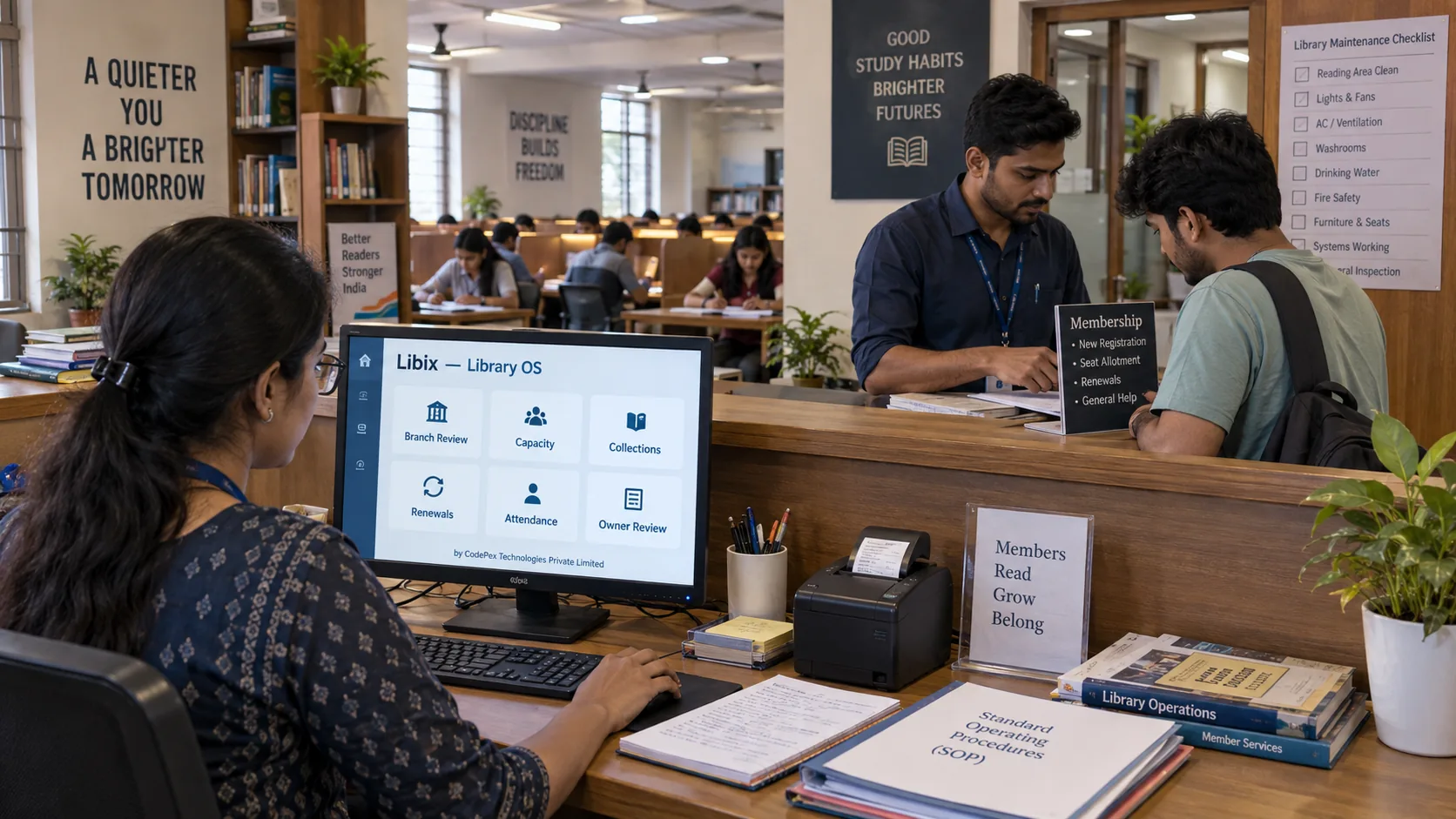
People still need a reason to pay, a place that supports concentration, a location that works, a price that fits, fair treatment, dependable facilities, cash-flow discipline, staff execution and owner judgment. Physical service is not replaced by a dashboard. Technology can support experience; it cannot perform care, fairness or local accountability by itself.
What owners should not chase automatically
Three plausible scenarios
Professional Local Operator
A strong single location differentiates through service, focus, records and local trust.
No probability assigned. Multiple scenarios may coexist.
Regional Multi-Branch Network
Several locations share definitions and governance while retaining local accountability.
No probability assigned. Multiple scenarios may coexist.
Hybrid Specialised Study Space
A physical study environment combines focused experience with carefully tested segment-specific services.
No probability assigned. Multiple scenarios may coexist.
No-regret capabilities
These are not promises of growth. They are capabilities that remain useful across several plausible futures.
A 12 / 36 / 60-month planning framework
12 months · Foundation
Clean records, financial control, service standards, permissions, exports, recovery and local market evidence.
36 months · Adaptability
Test selective automation, standardise repeatable work, improve capacity intelligence and evaluate branch readiness.
60 months · Strategic options
Review scenarios, interoperability, network governance, resource efficiency and experiments that have earned continuation.
These are planning horizons, not required technology deadlines or predictions.
Where Libix fits
A possible operating foundation—not a future roadmap promise
Libix is positioned around study-library operations such as members, memberships, seats, shifts, attendance, fees, payments, receipts, renewals and management information. The current availability of multi-branch governance, automation, integrations, AI, backups, permissions, reports or any future capability must be verified against approved product documentation and the live repository. Implemented, planned and architectural are different statuses.
Interactive Future-Readiness Scenario Planner
Prepare for several futures without pretending to forecast one
Explore strategic exposure and no-regret preparation. This planner presents scenarios, not predictions. It does not forecast demand, revenue, profitability, technology adoption or business success.
Current foundations
Concerns to examine, not forecasts
Scenario explorer
Professional Local Operator
One well-run location differentiates through focus, trust, service consistency and disciplined records.
Capabilities
Reliable member lifecycle · Clear service standards · Financial closing · Local feedback loop
Risks
Owner dependency · Local competition · Over-investing in features
Validate next
Document one core workflow · Protect records and exports · Test one service improvement
Frequently asked questions
Do study libraries have a future in India?
They may, because digital access to learning content does not automatically replace the need for quiet, reliable, dedicated physical study time. The future of any individual business still depends on local demand, service, pricing, capacity and execution.
Will online learning make physical study libraries unnecessary?
Not necessarily. Digital learning and physical study environments can coexist. One provides content access; the other may provide routine, focus, desk space, electricity, connectivity and separation from distraction.
Will every future study library use AI, biometrics or an app?
There is no basis for saying that. Owners should test a capability against a real need, privacy, cost, service quality, recovery and evidence instead of treating technology adoption as inevitable.
What should an owner build now?
Reliable records, financial control, capacity definitions, member service, clear staff responsibility, permissions, exports, tested recovery, local market understanding and technology optionality are useful across several possible futures.